And the winner is. . .
This Very Ground from Iron Ivan Games. What the . . . !?
If you've visited here before, you may be aware that I was already invested in This Very Ground for my French and Indian War project when I decided to give Muskets & Tomahawks a look. Overall, Muskets & Tomahawks is a very nice product. The N.C. Wyeth illustration on the cover alone gets a nod.
Recently The Baron pointed me to a post on Anatoli's Game Room that includes a thorough review of Muskets and Tomahawks as well as a "short comparison" with This Very Ground that I find quite useful. If you're interested, Mr. Anatoli also provides a similarly-thorough review of This Very Ground here (and I do hope Mr. Anatoli doesn't mind the links, but I would be hard-pressed to improve on his detailed reviews).
So why do I use the term "useful" to describe the comparison? The comparison provides an opportunity to show subjectivity in practice, as Mr. Anatoli and I look at the same points of difference between the rulesets and draw opposite conclusions, based ultimately, I think, on "what we like." Both systems quite obviously provide a good game and lots of period flavor. . . but as we all know, it often just comes down to what "feels right." Mr. Anatoli is calling Muskets & Tomahawks (M&T) his "go to" set of rules for the French and Indian War, while I have decided to stick with This Very Ground (TVG). For example, if we look at the comparison:
1) Shooting Mechanics. In M&T each soldier in a unit can take one action, which means some soldiers can move while others shoot while still others reload.
Individual soldiers' firings have to be tracked for reloading, which I don't like as well as the Volume of Fire in TVG, which is tracked by unit, and provides a neat little morale mechanism based on the amount of firepower a unit puts out.
2) Movement Mechanics. I prefer that in TVG Regulars are limited to Formed Formation, regardless of terrain, which makes them slow and cumbersome in the forest, all the time. Regulars don't get to break into skirmish formation for movement in the woods, which I think better reflects their European training prior to their arrival in the colonies.
3) Close Combat. I really like the "psychology tests" involved in the "Charge" and "Standing Ground" procedures prior to Melee. Used with the Initiative system, there is real finesse in the tactics of driving off the enemy with a volley and the threat of the follow-up with cold steel. If you can get to hand-to-hand, the new streamlined procedure makes Melee fast and lethal.
4) Casualties/Morale. TVG uses a roll to hit and a roll to wound based on a D10, and different Volumes of Fire provide Morale modifiers - the "psychology" of coming under fire is well illustrated. Using a D10 (rather than the D6 in M&T) allows Units to be defined more through differences in numerical ratings as opposed to the use of "traits." Morale is based on percentages of casualties in a unit - this coupled with the D10 means the game is scalable. A unit can be 5 soldiers or 20 and the game plays just the same.
M&T uses a deck of cards to activate units; it works fine. I prefer the Initiative-based system of TVG because it is a little sneakier - you can actually choose a disrupted enemy unit to activate on your Initiative and force to it take a Rally test that just might cause it to rout off the field if it fails. . .
M&T's Scenario Generator and Random Events are great features. No reason you couldn't use them with TVG, too.
So two really good game systems. . . and which one is "better" is totally subjective.
I'll be taking This Very Ground to Spring Recruits in April. See ya there, maybe!
The varnishing goes on. First up is a unit of Virginia militiamen, campaign ready. I repainted some of the leggings so even though there are three sets of "VM-04" shown, plus a single "Civilian Wagoneer," no two figures are "exactly alike."
Next up is the British Supply Wagon and the two new pack horses, accompanied by the Wagoneers.
I haven't forgotten the French, of course. This is the new Swedish 4 lb. cannon and Artillery crew.
And here's a couple shots of the same Artillerymen manning a swivel gun on the French defenses at Ticonderoga.
That's all for now. See ya!
Since I don't really do the social media thing, I thought I would "like" this book here. The book is Rome and the Sword by Simon James. The description from the dust jacket states:
The story of Rome and its military seems a familiar one, told often
through movies, books and games, yet it is a modern myth obscuring a
different reality. As this groundbreaking study demonstrates, Rome’s
military was no war machine made up of mindless cogs. There was not even
an ancient term for the Roman army; rather, Romans spoke of “the
soldiers”—of men, not institutions.
Simon James provides a
striking new perspective on Roman history by focusing on the soldiers
and their actions. Throughout the story of the sword - both as supreme, bloodstained exemplar of technology and metaphor of imperial power - we learn the violent reality of Rome's rule. Soldiers were less sentinels of civilization
than enforcers for aristocrats and autocrats against foreign foes and
internal dissent alike. They were brutal and unruly, prone to mutiny and
rebellion. How, then, to account for their sustained success and eventual failure?
Rome’s dominion was achieved through
soldiers’ ferocity and excellent weaponry, but to maintain it the
conquered were integrated, as diplomacy accompanied the threat of the
sword. Allies and subjects became Romans themselves - millions through
military service, bringing with them new arms and tactics. Yet the aggression of Rome’s soldiers
precipitated the rise of enemies in the east and north who would ultimately bring the empire to an end.
I am a sucker for anything having to do with Romans and descriptions of the ways and the whys of combat. As my reading of Roman history has focused more on the Republic than on the Empire, I learned a lot from this book. I was particularly struck by the analysis of the combination of "the sword and the open hand" with which the Romans created and sustained the empire.
I am sharing an old favorite, as well, in the light of all the attention that Studio Tomahawk's SAGA rules have attracted. I re-read The Last Apocalypse by James Reston, Jr. every few years and it always gets me excited about the "Dark Ages" again.
From the dust jacket:
Enter the world of 1000 A.D., when Vikings, Moors, and barbarians battled kings and popes for the fate of Europe.
As
the millennium approached, Europeans feared the world would end. The
old order was crumbling, and terrifying and confusing new ideas were
gaining hold in the populace. Random and horrific violence seemed to
sprout everywhere without warning, and without apparent remedy. And, in
fact, when the millennium arrived the apocalypse did take place; a
world did end, and a new world arose from the ruins.
In 950,
Ireland, England, and France were helpless against the ravages of the
seagoing Vikings; the fierce and strange Hungarian Magyars laid waste to
Germany and Italy; the legions of the Moors ruled Spain and threatened
the remnants of Charlemagne's vast domain. The papacy was corrupt and
decadent, overshadowed by glorious Byzantium. Yet a mere fifty years
later, the gods of the Vikings were dethroned, the shamans of the
Magyars were massacred, the magnificent Moorish caliphate disintegrated:
The sign of the cross held sway from Spain in the West to Russia in the
East.
James Reston, Jr.'s enthralling saga of how the Christian
kingdoms converted, conquered, and slaughtered their way to dominance
brings to life unforgettable historical characters who embodied the
struggle for the soul of Europe. From the righteous fury of the Viking
queen Sigrid the Strong-Minded, who burned unwanted suitors alive; to
the brilliant but too-cunning Moor Al-Mansor the Illustrious Victor; to
the aptly named English king Ethelred the Unready; to the abiding genius
of the age, Pope Sylvester II--warrior-kings and concubine empresses,
maniacal warriors and religious zealots, bring this stirring period to
life.
The Last Apocalypse is a book rich in personal historical detail, flavored with the nearly magical sensibility of an apocalyptic age.
The book is full of "larger-than-life" characters and stories culled from the Sagas of the time, as described by the author in the book:
The Last Apocalypse has all the background needed to construct a Dark Age campaign for Saga, DBA or even HOTT. Oh yeah, I've thought about it. . .
See ya!
No high-minded resolutions or lofty goals for 2013 here. Work has me pretty busy, so The Goal over the next few weeks is to further existing projects that can be tackled in smallish increments. So back to the French and Indian War and varnishing. Here are some civilian types completed over the holiday break. First up is a Canadian frontiersman bartering with a young Indian from the Jenkins' "His First Musket" set:
Next up are civilians from the "Civilians 1 and 2" sets, defending their homesteads. The figure in the center of the photo is "Samuel 'Sandy' Jenkins, Wagoner" from one of the Jenkins' Annual Collector sets:
This is a French Marine from the "The Prisoner" set escorted by "Prince, Rogers' (as in Rogers' Rangers) Servant:"
Can you say "Last of the Mohicans?" Cora and Alice come to you via "The Captives:"
Indians have been hunting and gathering; from "The Hunters" and "The Gatherers." The young man with the bow is the "Young Mohawk Warrior:"
And finally, two British naval personnel present, and killed, at the Battle of the Monongahela, "Spendelowe and Haynes:"
Some good "characters" that will add color to future skirmishes. Possibly at Spring Recruits : )
Happy New year. See ya!
. . . from Jack and the the Cluck Amok family to yours. May your dice always come up (choose one):
• ones
• sixes
• tens
• twenties
• other - I can't cover every game and die-type!
Happy Holidays and thanks for visiting my new space.
See ya!
I discovered John Carter and Barsoom in the mid-70's, while in high school, courtesy of the Science Fiction Book Club's editions of Edgar Rice Burroughs' eleven "Mars" novels, complete with cover paintings and interior illustrations by Frank Frazetta. I have been an unabashed fan ever since.
In the late 70's, Heritage Models, Inc. released a series of licensed 25mm miniatures and two manuals with which one could fight one's way across Barsoom. The manual pictured above includes rules for army-level combat with both air and ground forces as well as stand alone rules for ship-to-ship combat and a simple campaign system. The other manual (which I also own), the Adventure Gaming Handbook, features "man-to-man action rules" with a heavy dose of role-play. The mechanics are very dated, but both manuals have lots of good ideas for skirmishing and campaigning.
What I wanted to game was the ship-to-combat combat. The rules are functional; there are several classes of vessel ranging from "dreadnaughts" to scout flyers, movement is regulated by hexes and "elevation" is modeled, combat uses the good old CRT matrix and damage is recorded by checking off boxes on a "ship chart," with the occasional "critical hit" doing extra-fun-type damage. Some shots of the inside of the Manual:
It was the early 90's before I actually played the game (as The Baron may remember). There weren't any dedicated Barsoomian miniatures available, so I kit-bashed some "Space Battleship Yamato" plastic models along with some of the plastic minis from the classic "Space 1889" game. The interesting design sense of the Disney John Carter movie notwithstanding, I fully subscribe to the "sailing battleship" premise for the capital ships. Built and primed, here's how they looked in the half-dozen or so games we played before we moved on:
And then, twenty years later, New School Barsoom seems to have suddenly dropped out of the sky. It's called "Leviathans."
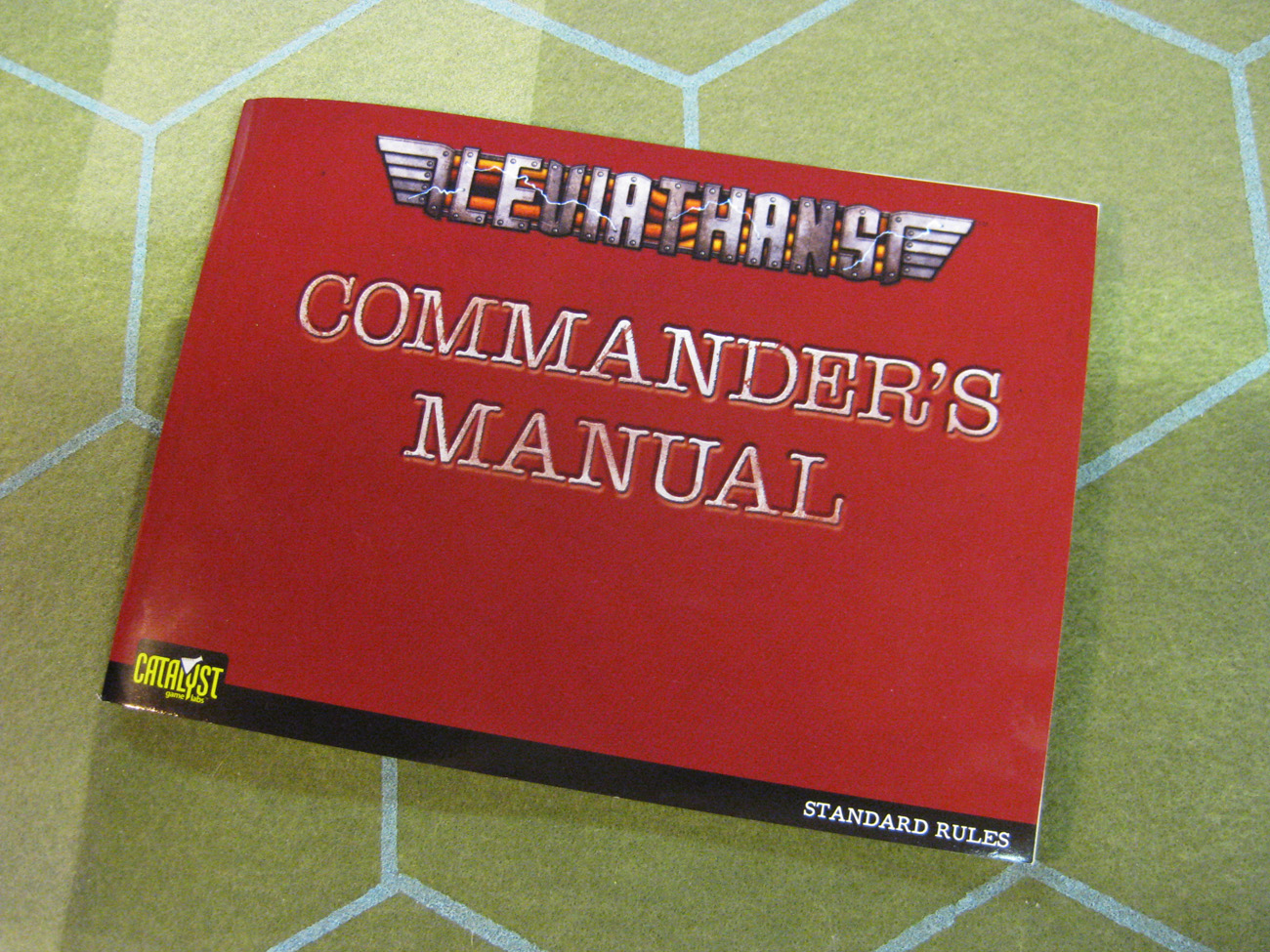
Leviathans doesn't know it's Barsoomian. It describes itself as Steampunk. I don't intend to review the game itself, which is actually quite good; you can learn more about it at Monsters in the Sky and Gameboardgeek. The rules have a similar feel to the Barsoomian Battle Manual, but are much more streamlined and very pretty to look at. See:
The rules could probably be used for Barsoomian air combat with just a few tweaks (bombing and boarding), but it is the models that hooked me. They are so very close to what I imagine the giant flyers of Barsoom to look like. Here is the French fleet included in the core game:
And the British:
I don't even mind the "Tesla Coil" apparatus in the hulls of the ships; who knows what "radium engines" and buoyancy tanks for the "Eighth Barsoomian Ray" might look like? Of course the "stacks" have to go, and a bit of streamlining might be in order. . . thus:
We'll see where it goes from here. . .
See ya!
Here is a look at the air force of the People's Collective, the Christian socialist nation in the Crimson Skies universe situated in what was once the upper midwest of the United States and part of Canada; specifically Iowa, Kansas, Nebraska, South Dakota, North Dakota, Manitoba and part of Saskatchewan. As the Collective's principal enemies are The Industrial Sates of America and the Republic of Texas, they serve as the generic military "bad guys" in our game universe.
The Collective is represented by the the militia squadron, the Wichita Windstorm, based obviously enough in Wichita, Kansas. The squadron is built around a single Scout-class Zeppelin, the Windshear:
Model info: this is a stock build of the Revell 1/200 scale Zeppelin NT plastic kit. I added turrets and guns along the hull sides.
The squadron's aircraft are organized into three Wings. Red Wing consists of one Stalwart and two Defenders, all Collective-designed and -built planes:
Blue Wing is organized just like Red Wing:
Yellow Wing has some unusual assets for a Collective squadron; aircraft "purchased" outside the Collective. The light, fast Buccaneer performs scout and reconnaissance duty while the lumbering, armored Phalanx is used in ground attack roles:
And glider-borne tanks! The Collective has been experimenting with "break-away" gliders as a means to drop heavy support weapons into border hot-spots when needed:
Now we have enough aircraft to play. . .
See ya!