Game Three featured The Baron's new horse and musket variant for his Fistful of Lead rules. Designed primarily for western gunfights, The Baron is adapting them for use with my favorite horse and musket conflict, the French and Indian War, and we got to participate in an early playtest. Have a look at the preview in the link above to get an idea of how the game plays.
On to the game itself. We had 8 players again, 4 per side, each player running 5 models. We played basically the same scenario used in the earlier two games. The British had a unit of 5 Regulars, two units of 5 Civilians/Militia and a unit of 5 Rangers (run by yours truly). The French consisted of two units of 5 Natives, one unit of 5 Coeur De Bois and a unit of 5 Marines.
The Civilians/Militia started the game in the homesteads; the remaining players decided on their models' entry points when they activated per the card draws. The Marines and a unit of Natives entered along the north edge in the woods, the other Natives and Coeur on the western edge in the woods, with the British Regulars entering on the road on the eastern edge, while I took up a position in the woods along the southern edge facing the southwestern homestead.
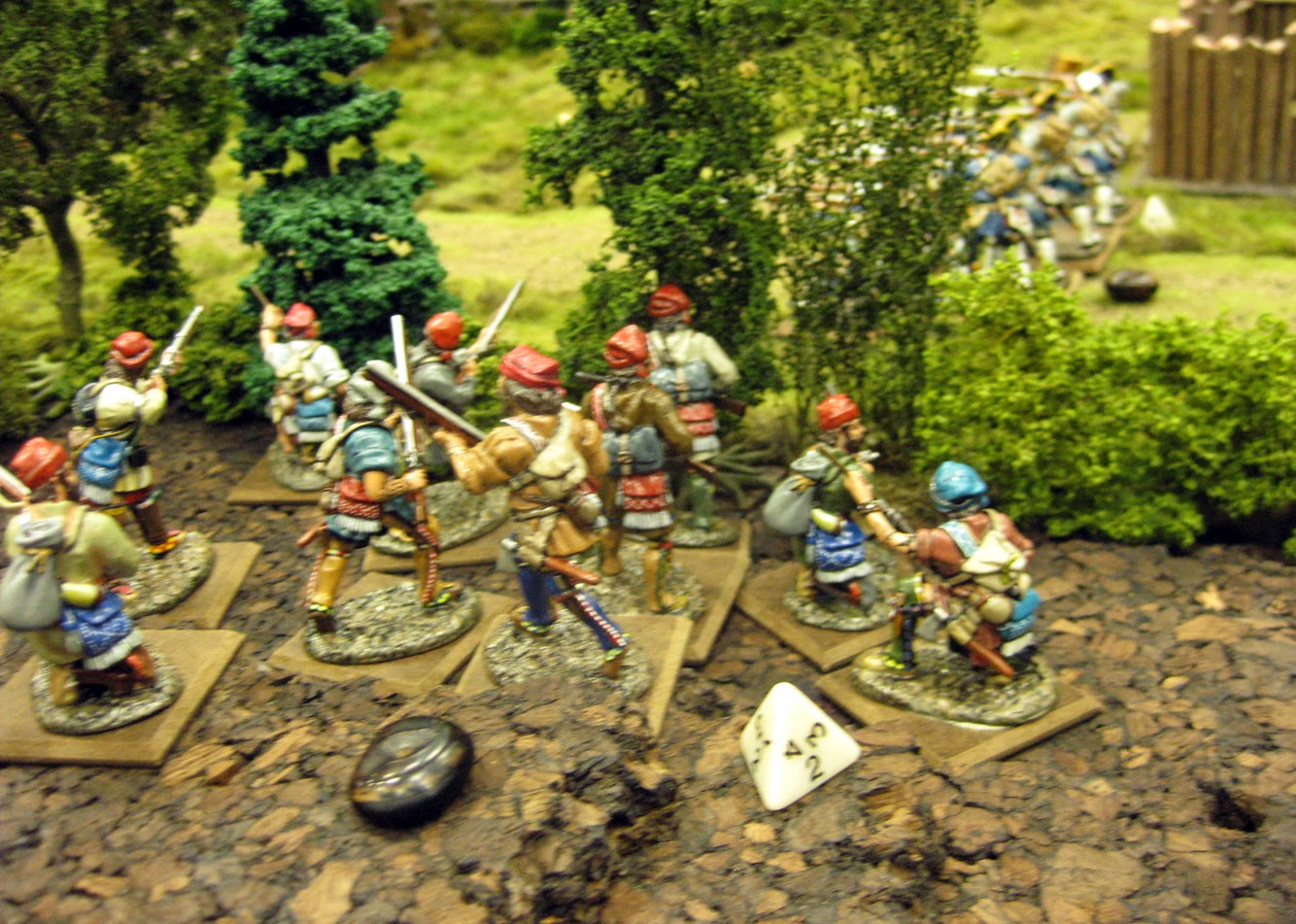
I forgot to take pictures for the first couple of turns while I was "learning" the game. So about Turn Three, the Natives and Coeur were crossing the river under fire from the homestead. Unfortunately they were still out of range of my Rangers, and despite The Baron's disdain, I was in no hurry to leave the cover of the woods.
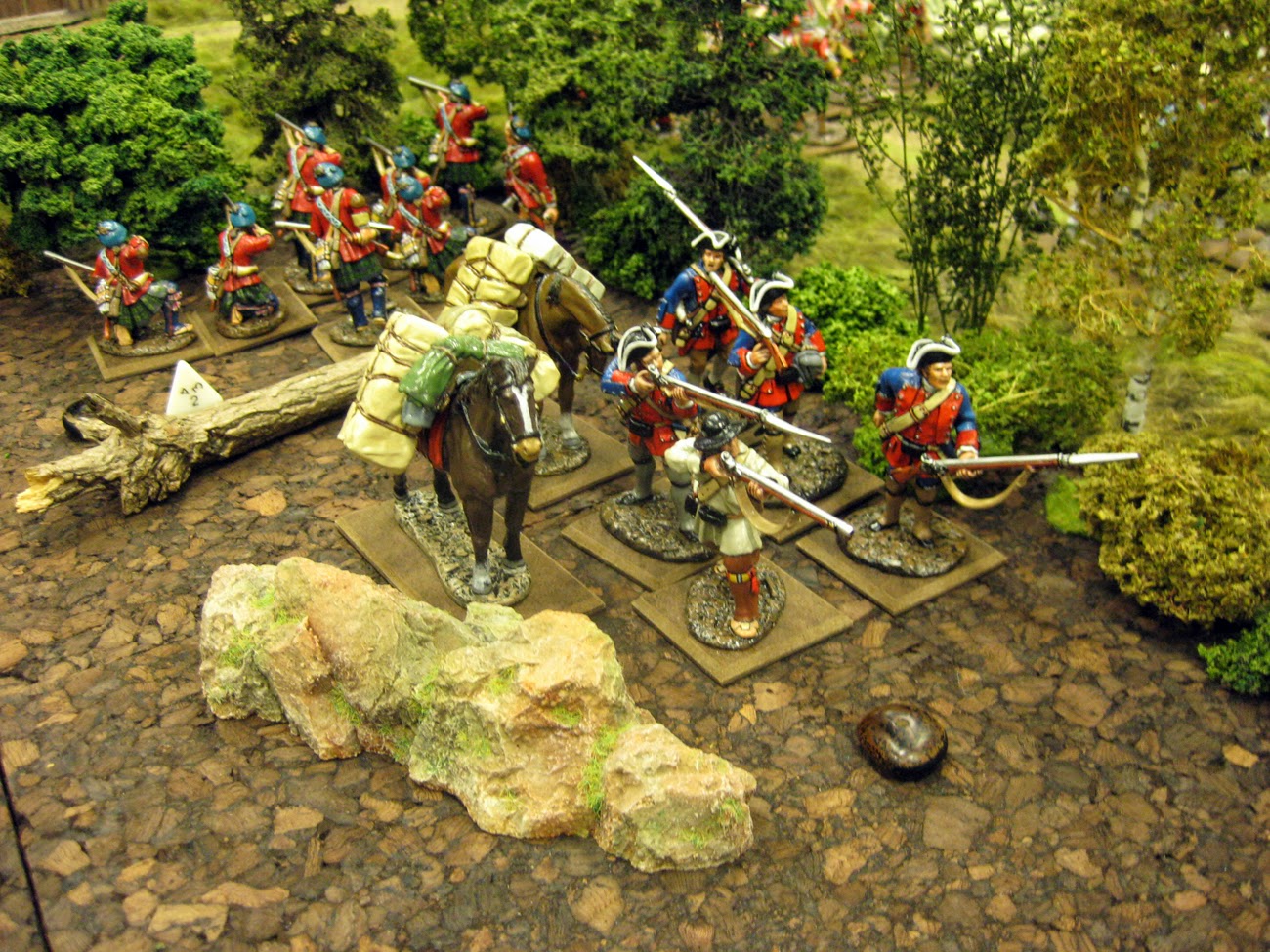
The British Regulars had joined their Militia bretheran in the northeastern homestead. . .
and the Natives and Marines were at the edge of the north central woods, firing on both homesteads.
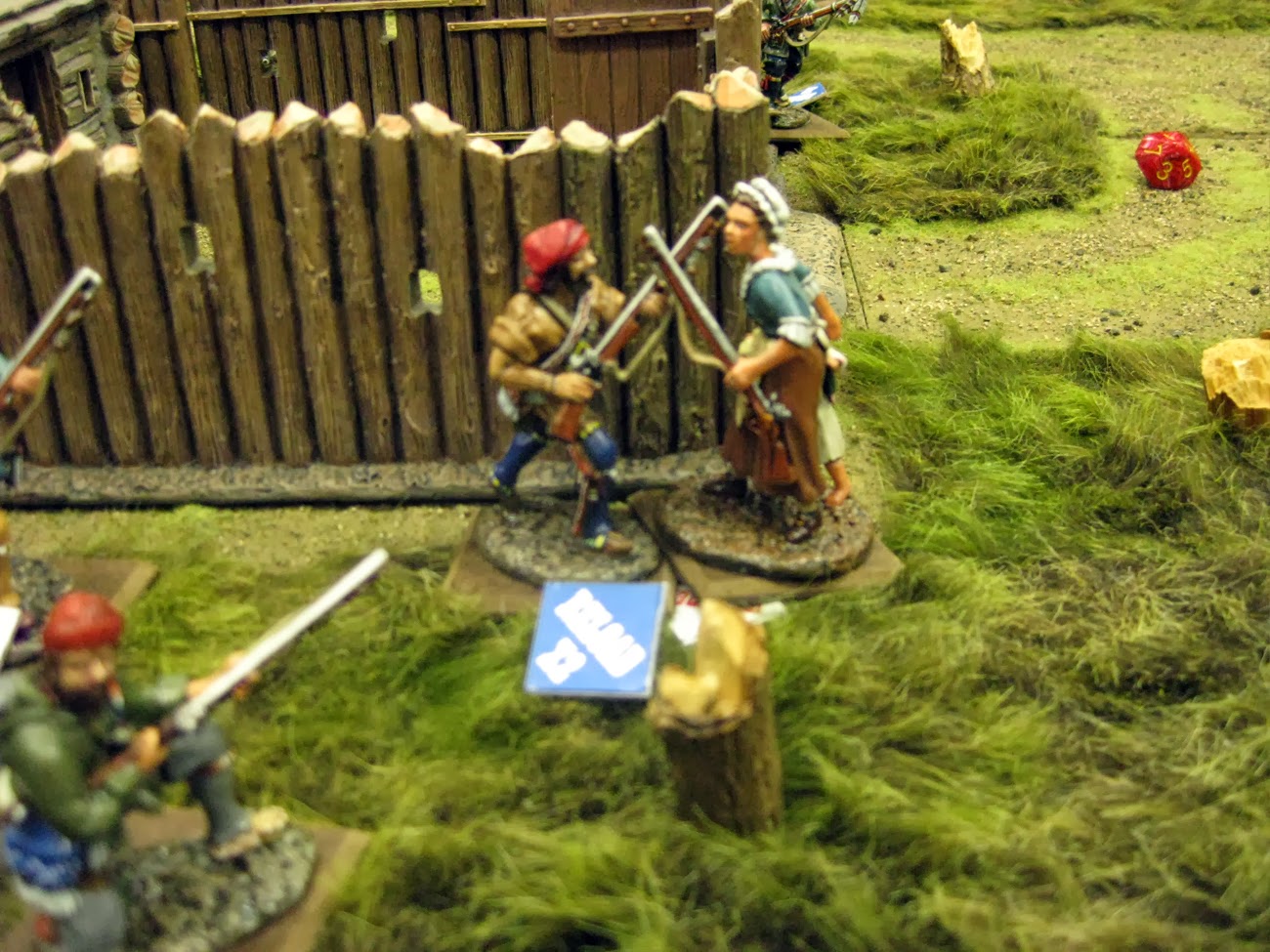
The fight around the southwestern homestead was brutal. Though outnumbered, the Militia fought back heroically, especially Molly MacGregor (the only character in this game to be officially named, beside "Whack-a-Mole, a Militiaman who spent the entire game getting knocked down and jumping up again), who, though wounded and burned as the Natives fired her home, shot two of the Natives herself.
I was able to keep the Marines and Natives in the northern woods pinned down as they made for the southwestern homestead, but was not able to effect the fight itself.
One of the Militia took advantage of this covering fire and made a break with one of the pack horses.
Under cover of the Regulars, the Militia in the northeastern homestead also made their break with the packhorses.
Her home aflame, Molly takes her chances with the packhorse, her young'un close at her side.
But a bullet from the woods spooks Molly's horse, which bolts, knocking her down and stomping on her leg, wounding brave Molly. Despite the Rangers' covering fire, one of the French Coeur runs up and nabs the horse.
Though burned, shot and stomped, Molly was not going to let those nasty French brutes have off with her things, and charged the nearest of the offending Coeur. She discharges her musket at point blank range. . .
. . . and misses! Then the brute knocks poor Molly to the ground, inflicting a grievous wound.
So the Coeur De Bois were off with their prize, and despite my best efforts (from afar, as noted again), without a loss.
Despite a close-run fight at the northeastern homestead, which the Natives succeed in setting ablaze, the Militia escape with the pack horses.
And when we had to call "time," the third pack horse was also en route to safety, though deterred by a jaunt through the woods.
The score? The French and Natives burned both homesteads and stole one of the pack horses; the British retained 3 of the 4 pack horses. Casualties were light on both sides. The Baron declared the game a draw, with a slight nod to the French.
The game was great fun and provided a fun and believable narrative. I played it very safe, and kept 4 of my 5 Rangers alive, but allowed the Coeur to make off with one of the pack horses. No guts, no glory. . . c'est la vie.
I have been on the fence about skirmish scale gaming, having mostly played at army level and preferring it. But big miniatures and a "frontier campaign" lend themselves very well to a more personal focus on individual fighters and I will be revisiting this topic, I think.
Thanks, Baron.
Next up, a bit of travelogue.
See ya!
Our second game had 8 players, too, and the British manned the homesteads just like their counterparts did in the previous game. The crafty French commander broke with tradition when he activated the Virginian Provincials in the southwest homestead with his first activation, presuming the Provincials would hunker down in their position (pass on activation) and thereby make it safer for the French to maneuver around the stockade. Instead the Virginians took the pack horses and stole a march on the surprised Frenchmen!
Both sides then mostly took turns activating each others' troops to get them onto the field, which stranded the poor Civilians in the southwest homestead alone without Provincial protection, and surrounded by Natives and French Regulars.
Also different from the previous game, only one Native unit entered on the eastern half of the field, arriving in the woods on the southeast corner. All the other French and Native units entered on the western half, mostly in the woods on the northern edge.
This effectively created an east-west axis between the British and French forces. . .
. . . except for the Natives in the southeast section of the woods, which the British screened with the Highlander Light Infantry. . .
and the Civilians in the southwest homestead, now surrounded, pinned down by musket fire and a newly-started blaze. . .
while the Provincials head eastward with the pack horses.
A volley of fire from the French Regulars and skirmish fire from the Coeur and Natives in the woods disrupt the Provincials, who seek safety in the woods south of the road, and nearly into sight of the Natives lurking there.
This forced the British to send the Highlander Light Infantry into the woods and after a brief firefight that caused no casualties, the Natives charged the Highlanders. The Highlanders won initiative and slaughtered the Native unit completely, losing two of their own soldiers in the melee (hand-to-hand combat in This Very Ground is a fight to the death in one turn). In another turn the Highlanders were in position to screen the Provincials while they rallied.
By this point the British were able to form a solid screening line. . .
. . . for the civilians in the northeast homestead to make a break with the pack horses.
The British were able to get all four pack horses off the field. The French tainted the British victory by burning the southwest homestead and killing and/or capturing the beleaguered Civilians left behind.
A well-played game that went right down to the wire.
Check back later this week for a look at Game Three featuring The Baron's Fistful of Lead.
We had eight players in Game One, four on each side, so each player handled 2 units. Both sides used their activations to force their opponents onto the field. The French ended up with their Coeur De Dois in the open north of the northeastern-most homestead, and Natives in the woods on both the south and north edges.
Add the French Regulars on the west edge and the Provincials and Civilians in the western-most homestead were effectively bottled up.
Outside the eastern homestead, the combined firepower of the Provincials and the newly-arrived British Regulars routed the Coeur. While the Rangers screened the Natives in the woods to the south, the Provincials and Regulars marched toward the western homestead in support of their besieged comrades.
The Natives outside the western homestead manage to start a blaze as the musket fire from the Irregulars and the Natives at the edge of the woods keep the Civilians pinned down in their now-burning homestead.
The Regulars of both armies now form up and fire away at each other along the east-west road.
At this point we had to call the game for time, and we declared it a draw. The British were about to lose the western homestead to the torch, and with it the units of Civilians and Provincials, and the all-important pack horses inside. The position they established between the homesteads seemed to insure they would not lose the eastern homestead. The French had lost their unit of Coeur De Bois and were close to losing a unit of Regulars. So with each side in "possession" of a homestead, a draw seemed the fair call.
Check back for Game Two later this week. . .
It's raining today, so I can't seal the new deck. Great excuse to catch up the blog : )
The scenario for the games we played at Recruits XXII was borrowed - quite liberally - from a scenario found in the Iron Ivan Games Yahoo Group: French Raid Scenario - New.pdf. The terrain layout is shown above in the map; north is the top edge. Here are photos of the actual terrain. The view form the northwest:
From the northeast:
From the southeast:
And from the southwest:
And the homesteads prior to their troop assignmments:
The scenario is a basic raid. The American Provincials start on the field in control of the homesteads. The French and Indian forces are raiding the frontier. The British are aware of the raid and have sent regulars to help defend the homesteads.
The British win if they are able to get the 4 pack horses - 2 start in each homestead - off the eastern edge of the field via the road. The French win a major victory if they are able to get the pack horses off the western edge of the field via the road, and a minor victory if their native allies are able to burn down the settlements and/or capture any of the civilians.
The British started with two units of 5 civilians (Miitia in This Very Ground terms) and two units of 10 Provincials, and placed one of each in each of the two homesteads. These 4 units were commanded by a Provincial officer. A British officer commanded another 4 units, one unit of 10 Regulars, one unit of 10 Grenadiers and one unit of Highlander Light Infantry that would enter the field anywhere on the eastern edge, and one unit of 10 Rangers that would dice for a random entry point on their first activation.
The French had 8 units total, too, none of which started on the field. One Marine officer commanded 4 units; 2 units of 10 Marine Regulars and one unit of 10 Marine Irregulars (Light Infantry) that would enter from the western edge, and one unit of 10 Natives that would dice randomly. The second Marine officer commanded 3 units of 10 natives and one unit of 10 Coeur De Bois, all of which would dice randomly.
The Native units had 8 torches to split up amongst the 4 units, and those warriors carrying torches could use them to assault the walls of the homesteads, starting a fire, or subsequently stoking it, if scoring successful wounds. 5 wounds would be enough to burn down a homestead. The homesteads could otherwise be assaulted by winning a melee roll against the door, the score needed starting at 1 and rising by two each turn the attack fails. Units inside can then be charged normally.
This Very Ground permits a player to activate any unit, friendly or enemy, during his or her activation, and this made for some interesting choices early in the games, especially for the British. Does one use an activation to get an early start with the pack animals, not knowing where the enemy is exactly, or does one choose an enemy unit to dice for entry point and activation, potentially finding them threateningly close to your path, but at least knowing where they are?
Look for more on the games themselves in future posts. . .