Showing posts with label 15mm. Show all posts

Tuesday, April 27, 2021

Commands & Colors


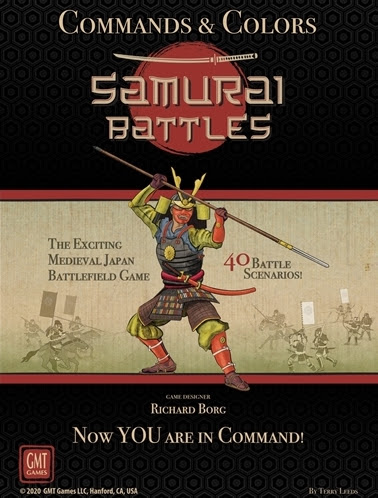
I received my copy of Commands & Colors: Samurai Battles a week ago as part of the GMT PS500 program. Got Bayonets & Tomahawks, too!

I've been a fan of the game system since the Ancients version was released. It's card-driven, but it feels like DBA to me (remember I consider that high praise), in scale and unit treatments, with the addition of rules for attrition. I have all of the Ancients supplements, plus Medieval and Red Alert (the "space combat" variant).

Of course I am converting the games to miniatures. My plan has been to use 4" hexes and 15mm miniatures mounted on 40mm wide bases for Ancients, and that may still continue to happen, but I am also now considering using 54/60mm models for at least my "favorite historical conflict," the Punic Wars. Not intuitive, I know; we lose the "mass effect" with fewer, bigger models representing each unit. I can still use 4" hexes, like I have been doing for 15mm figures, and use one model to represent each "block" in the game, so most Ancients units will consist of 3 or 4 models. Might even be able to use some of the same hex terrain for both scales with some careful planning.

Why go this route? The main driver is I have never been totally satisfied with any of the 15mm or 28mm Republican Roman models I've encountered. I really like the John Jenkins Designs models for both accuracy (I know, right?) and drama. The Gauls are stunning.

Then, one must determine in what "world" the models will live and fight, and playability is key. These models tend to be top-heavy, so either they need wider bases for added stability on uneven terrain, or the terrain needs to be very flat and even. My French & Indian War terrain and basing is a good example of the former.

Since I am more interested in playing large battles than skirmishes, terrain can be less detailed and more abstract. . . and flat. That means the bases of the models won't need to be enlarged. One thing I do want is magnetic bases, so the models will stay put in their traveling boxes. After a bit of experimentation, I found a self-adhesive magnetic tape that can be cut to the silhouette of the base edge of the model. The tape is only 1mm thick, so with a bit of paint and flocking after the fact, it won't even be noticed, and the base will visually blend with the terrain. How strong is the magnetic effect? I applied to a "left-over" French Regular as a test and he can crawl right up a metal cabinet like Spider-Man!

Basing potentially solved; on to the terrain. How flat is flat? Can't be boring. . . and we still need to represent hills. Can't have slopes, though, for the above-mentioned reasons, and for the same reasons the "tops" of the hills have to be flat.

Years ago I purchased a quantity of GHQ Terrain Maker foam hexes; I hauled some out and started making terrain. The goal was a "scrubby" Mediterranean look. I started with a sandy brown latex house paint; literally sandy as I mixed sand into the paint. This texture hides the surface look of the foam itself. I then followed that up with 3 different colors of fine green flock, held in place with sprayed coatings of diluted white glue. Multiple, soaking coats is key. The foam hexes come in 4 different "heights," providing instant flat hills.


Some other special, easily recognized terrains are needed, too. Woods, for example. I can do Woods. Again, playability is important, so I opted for a single large tree in the center of the hex that would leave enough room for the models. For the hex base I started with the same dark brown latex house paint color I use for the French & Indian War bases and layered on some brighter green flocks and "leaf litter." Here are some Woods and Clear hexes next to each other - and not every Woods hex has to have a tree.


Can't forget about the Rough/Rocky ground. I mixed a little paper mache into the latex paint and layered on some fine gravel with a little less green flock. Goal is still as flat as possible, but the look should be "rocky." A helpful feature of the foam hex is that you can actually press any high spots down into the foam after the glue dries and spray on another layer of glue.


I haven't attempted any water features yet but have a pretty good idea of how I will handle them. Here's how the terrain looks with Roman legionaries on the advance.


A little paint and flock and the bases of the models will blend right in to the terrain. I'm sure it won't surprise you to learn I have a "house rule" or two in playtest mode. And I will still be able to skirmish since the models are individually based. "Short" distance for SAGA at this scale just happens to be the width of a 4" hex. . .

See ya!


Wednesday, January 1, 2020

Happy New Year!


2020 is here! I rang in the new year rather quietly, due to a massive head cold, and rather than make any bold pronouncements about the coming year, thought I would play a little catch-up with this post.

Bruce and I have been playing DBA 3.0 once a month for the past several, and he's been supplying the 28MM armies and choosing some interesting match-ups - more or less historical - so here are the recaps. 

October: Army II/5e Aitolian vs 2/5f Phokian. A 2/5 Later Hoplite Greek rumble except the Aitolians get very few Hoplites! We played a double-size game - 24 elements with 2 Generals. . . and the Aitolians have 14 Psiloi with only 8 Hoplites and a pair of Light Horse. The Phokians have more Spears, a few Psiloi, Some Auxilia and a pair each of Cavalry and Artillery (bolt shooters). A very interesting match-up between 2 Aggression 1 armies, though the Phokians look highly favored.

We rolled for army choice and I lost; so I got the Aitolians and all those Psiloi. Bright spot was that I was defending, so with DBA's terrain generation system I had a chance to get some terrain to help even things up. And I got some - a woods and some rough going in the center of the table! The plan would be to get the Psiloi into the woods and rough terrain early, use the Light Horse to harass and look for good match-ups to occur. A long shot but not impossible. 

I got to the woods first and sent the Light Horse out on a wide flanking maneuver.


The woods became a fulcrum that leveraged the two Phokian commands apart, though they sent their Auxilia, and even some Cavalry to try to clear out the Psiloi. I refused both flanks while the Light Horse raced around the back of the Phokian army, drawing off the Phokian mounted in pursuit.


The Light Horse picked off a couple elements on the left flank before being chased away by the Phokian Cavalry while both armies traded casualties in the center in the Woods.


After the Phokians lost both their generals on the flanks (the Phokinan general fighting on my left flank survived a couple of surrounded combats before succumbing) I pushed hard on the right flank - including bringing the Light Cavalry all the way back to the flank they started on - against the Phokian command with the Artillery and just squeaked out a win!


November: Army II/30b Galatian vs 2/6 Bithynian. A historical match-up in that the Bithynians were originally responsible for bringing the Gauls to Asia to help in a civil war! The Galatians were mostly Warband with some Psiloi, Cavalry (including chariots) and a Scythed Chariot. The Bithynians were mostly Auxilia and Psiloi with a couple of Light Horse. 

I rolled up the Bithynians and defended again; terrain would have no effect in this game. I liked the match-ups; the Auxilia and Psiloi should be able to handle the Galatian warbands.


The Pip Gods were generally good to me. I sent the Light Horse out to draw off the Galatian mounted and pushed forward to the general engagement. The Psiloi screening the Auxilia broke up the Warband charges as planned, and some early Bithynian casualties and good Pip rolls allowed the Auxilia and Psiloi to create some hard flanks when the Warbands pursued into overlaps.


The Bithynian second line filled in for losses in the center and supported the left flank against the Galatian mounted and Scythed Chariot attack, while the Auxilia and Psiloi won the battle in the center against the Warbands.


December: Army II/32a Later Carthaginian vs 2/56 Early Imperial Roman. Bruce brought 15mm Romans - a bit too late in period to be historical - to face off against my Carthaginians. We played a full Big Battle game of 3 commands each. Roman blades are always scary, but the new side support rules for Spears in 3.0 helps even the odds.

The Romans were Blades supported by Auxilia, Psiloi and a few Cavalry, arrayed in three lines. My Carthaginians had a command of 8 Spear and 2 Elephants with Psiloi and Cavalry, a second command of 8 Gallic Warbands and 2 Cavalry, and a third command of 8 Light Horse and couple Psiloi. The Carthaginians were attacking so were able to place the Light Horse command last. The Romans placed a BUA during the terrain phase, but it and the rest of the terrain proved inconsequential.


My initial Pip roll was awful but I eventually managed to get the Light Horse command into action and advance the main battle line.


The Romans countered the Numidian Light Horse with their mounted, but were not able to get their third line into the fight.


The Romans then fed two of their Generals into the fight with the Light Horse, which could not be extricated as the fight grew larger. As the Gauls closed in support, the Spears and Blade battle lines embraced. A couple of early Blade casualties led to the Spears gaining overlap advantages in subsequent combats. 


The Punic Spears held firm in the center, handing the Romans more Blade losses, and with the elimination of two Roman generals to the Numidians, 2 commands became demoralized, for a Carthaginian win.


The difference was that third Roman line that never got into the fight. The Carthaginians were able to get more of their elements into combats than the Romans.

Lots of fun. See ya!