Showing posts with label Saga. Show all posts

Monday, February 8, 2021

It's Been A Little While. . .

The last time I posted was on the eve of the Chief's first regular season win of the 2020 season, and here we are now hours after their one-sided loss in Super Bowl 55. The Chiefs had plenty of heart, they just didn't have the tools. Repeating is really hard. . .

So why the lapse in posts? Well, not playing any games for almost a year hasn't exactly been an inspiration, and I haven't had a lot of free time, either. Thankfully, I have been very busy with work, and when I had hobby time, I spent it building terrain or reading new rule sets. LIke what, I hear you ask?

I finally built some corn fields. Can't really play wargames set in North America without corn fields, and they'll be useful for the Aztec and Conquistador project waiting in the wings, too. I started with the Britains corn models and then repainted and added greenery to the bases.


 Also working on some more woodland terrain, featuring some rock outcrops to fight "around."


Still flirting with skirmish gaming in other, more ancient periods, so have been reading some new rule sets. Really like what the SAGA folks have done with Age of Hannibal; I think the "factions" have real character. 


Finally a plug for a board game I am excited to finally get my hands on, Bayonets & Tomahawks. I posted about it previously after getting an opportunity to do some play-testing. It will make a perfect vehicle for campaigning with the French & Indian War, if we ever get back to that kind of gaming! The "period" map is just stunning. Here is the link to the author/designer unboxing his production copy of the game.


 See ya.

Sunday, February 7, 2016

Lion Rampant?


Yup. And Dragon Rampant, too. Do I like em? Yup. Wanna know why? Because they remind me of DBA/HOTT. A lot. And you know coming from me that's high praise.

So how are they similar? Both games primary design goal was for a simple, fast game. DBA 3.0, in its introduction, says, "Our original intent was to provide the simplest possible set of wargames rules that retain the feel and generalship requirements of ancient or medieval battle." Similarly, Lion Rampant states,"Keep the rules simple, streamlined and abstracted where appropriate: don't make players continually thumb through the rulebook. Quick play and minimal record-keeping to allow multiple games in one session." DBA 3.0 concurs: "A game usually lasts less than an hour, so that a 6 round convention competition can be completed in one day. . ."

Significantly for me, their key similarity is the way the combatants are defined. As DBA 3.0 describes: "Wargamers pay more attention to weaponry than did ancient commanders. Surviving ancient manuals lump all foot skirmishers as psiloi whether armed with javelins, sling or bow, defining them by function rather than armament. We have applied the same principle throughout with no apparent loss of overall realism. Morale and training distinctions have also been discarded as linked with function. Thus, most knights are rash, all warbands are fierce but brittle, all skirmishers are timid."

Lion Rampant takes a similar approach: "Embrace medieval caricatures: knights should be headstrong, spearmen resolute, tribesmen fierce, and light cavalry agile. Performance is abstracted: make sure units 'feel' right." Unlike DBARampant embraces unit training upgrades and downgrades, providing some differentiation between "green" and "veteran" units. Again unlike DBA, Rampant uses a point system to build equivalent opposing forces.

Here's a spreadsheet I built showing how the two game systems classify similar troop types in both "historical" and "fantastical" manner. . . I know.


Both games use about the same number of models to represent an "army;" about fifty figures, give or take a few, depending on the army. This permits one to collect a variety of different armies when one has budget or time constraints. Aesthetically, this works in Lion Rampant's favor, as it is designed to represent skirmishes, as opposed to DBA's focus on classic field battles. Another nod to the skirmish level of Rampant is the use of scenarios, which provides some variation from the classic "line 'em up and go at it" nature inherent to larger battles. Models are based individually in Rampant, instead of on "elements" of 2 or more representing larger units in DBA, and this also appeals to the "skirmish aesthetic" because terrain can be more complex and interesting when you don't have to accommodate large bases. I hope it's become apparent that building convincing terrain has become a big part of the hobby for me. 

HOTT (the fantasy companion of DBA) has been criticized (not by me) for an overly simplistic representation of magic, and if that is your assessment, you may like Dragon Rampant's simple but more detailed spell system.

Rampant uses an activation system that has become fairly common today; an activation roll on one or more dice, but gives it a nice nuance by rating each type of unit for movement, shooting, charging and morale, neatly giving each type (knights, spearmen, etc.) a personality and definite battlefield use.

What does all this mean? I am definitely not leaving DBA 3.0 for Ancients "army-scale" gaming, and may use 15mm to get more of that "massed army" feel, but for my Dark Age/Fantasy gaming I am seriously considering moving toward the Rampant family of rules and individual basing, and using some of my F&IW terrain in dual service. Individual bases also have the added advantage of permitting other skirmish rules to be played, too, should I get the opportunity.

And, because someone is bound to ask, "How does Dragon Rampant compare to Saga?" here is my take. I understand why the battleboard system, with special boards and dice for each Dark Age faction, is appealing to gamers of the period. In most wargames rules, one Dark Age warrior fights much like another, so the battleboards and faction-specific rules of Saga give each warband a unique personality. But for me, the system intrudes upon the game "experience;" I am too conscious of the game and its mechanics and less involved with the "narrative" unfolding. 

So we'll see if this goes anywhere. I am deep into the Great 54mm Basing Upgrade still. . .

See ya!


Monday, August 24, 2015

Recon, Recruits and Samurai


This weekend I visited Recon, a local "game event" held at the Geek Partnership Society in Minneapolis and organized by Mr. George Hord (Thanks, George!) Bruce and I planned to play some DBA/HOTT/D3H2, but Bruce wasn't feeling well so I decided to just go and see some friends. Mr. Hord was playing modern MicroArmor, Mr. James was playing 15mm American Civil War with Regimental Fire and Fury and Mr. Ladd was playing a 28mm Napoleonics game with "a new set of rules with an unpronounceable French name." 

Also got to watch a demo game of SAGA played between Jim (Vikings) and John (Norse-Gael). John hosted the game and provided both of the very-nicely-painted warbands. . . so I have to apologize for the lousy cell phone photo of the game above, which does not do it a semblance of justice, taken on the last turn when the game had come down to the feuding warlords and a handful of supporters. I have the rules and the dice, of course, and lots of figures waiting for paint. . . we'll see if this was enough inspiration to start applying that paint. John and Jim were both very welcoming and patient with my watching (er. . . questions). Thanks!

Still making progress on the F&IW game project for Recruits next month. Here are some "garden fields" I made from Build-A-Rama mats, which are also usable for DBA:


Here are the John Jenkins Indians and Rangers with their new basing:


I have a bit more terrain to finish up but the project seems to be well in hand now. I will post a map and a bit about the scenario next week. 

Friday the Steel Fist Miniatures Kickstarter order arrived. It's always fun getting "little guys" (as Lady Amok refers to them) in the mail! Between Perry and Steel Fist we now have all the important daimyo at Sekigahara in 28mm. 

The figures are quite good; well sculpted with some separate heads, weapons and banners. Even the packaging is nice - printed boxes with "matchbox" sleeves.


Steel Fist also has decal sheets for nobori and sashimonos, too. Gorgeous. A lot of the appeal of the Sengoku Jidai period for me is the graphic design. Here are some photos of the minis and decal sheets:


And, because someone I am sure is wondering how the Perry and Steel Fist minis compare, here is a photo. . . wait for it. . . comparison. Steel Fist on the left , Perry on the right. 


The humans work together nicely, with similar size proportions, even if the Steel Fist minis are just a tad heftier. Not so for the horses; the Steel Fist horses are "heroically larger" in proportion, though I think one could use them with Perry models as long as they weren't next to each other on the same stand. We'll definitely see about that sometime in the future. Definitely.

See ya!


Sunday, January 13, 2013

Book "Like"


Since I don't really do the social media thing, I thought I would "like" this book here. The book is Rome and the Sword by Simon James. The description from the dust jacket states:

The story of Rome and its military seems a familiar one, told often through movies, books and games, yet it is a modern myth obscuring a different reality. As this groundbreaking study demonstrates, Rome’s military was no war machine made up of mindless cogs. There was not even an ancient term for the Roman army; rather, Romans spoke of “the soldiers”—of men, not institutions.

Simon James provides a striking new perspective on Roman history by focusing on the soldiers and their actions. Throughout the story of the sword - both as supreme, bloodstained exemplar of technology and metaphor of imperial power - we learn the violent reality of Rome's rule. Soldiers were less sentinels of civilization than enforcers for aristocrats and autocrats against foreign foes and internal dissent alike. They were brutal and unruly, prone to mutiny and rebellion. How, then, to account for their sustained success and eventual failure?

Rome’s dominion was achieved through soldiers’ ferocity and excellent weaponry, but to maintain it the conquered were integrated, as diplomacy accompanied the threat of the sword. Allies and subjects became Romans themselves - millions through military service, bringing with them new arms and tactics. Yet the aggression of Rome’s soldiers precipitated the rise of enemies in the east and north who would ultimately bring the empire to an end.


I am a sucker for anything having to do with Romans and descriptions of the ways and the whys of combat. As my reading of Roman history has focused more on the Republic than on the Empire, I learned a lot from this book. I was particularly struck by the analysis of the combination of "the sword and the open hand" with which the Romans created and sustained the empire.

I am sharing an old favorite, as well, in the light of all the attention that Studio Tomahawk's SAGA rules have attracted. I re-read The Last Apocalypse by James Reston, Jr. every few years and it always gets me excited about the "Dark Ages" again. 


 From the dust jacket:

Enter the world of 1000 A.D., when Vikings, Moors, and barbarians battled kings and popes for the fate of Europe.

As the millennium approached, Europeans feared the world would end.  The old order was crumbling, and terrifying and confusing new ideas were gaining hold in the populace.  Random and horrific violence seemed to sprout everywhere without warning, and without apparent remedy.  And, in fact, when the millennium arrived the apocalypse did take place; a world did end, and a new world arose from the ruins.

In 950, Ireland, England, and France were helpless against the ravages of the seagoing Vikings; the fierce and strange Hungarian Magyars laid waste to Germany and Italy; the legions of the Moors ruled Spain and threatened the remnants of Charlemagne's vast domain.  The papacy was corrupt and decadent, overshadowed by glorious Byzantium.  Yet a mere fifty years later, the gods of the Vikings were dethroned, the shamans of the Magyars were massacred, the magnificent Moorish caliphate disintegrated: The sign of the cross held sway from Spain in the West to Russia in the East.

James Reston, Jr.'s enthralling saga of how the Christian kingdoms converted, conquered, and slaughtered their way to dominance brings to life unforgettable historical characters who embodied the struggle for the soul of Europe.  From the righteous fury of the Viking queen Sigrid the Strong-Minded, who burned unwanted suitors alive; to the brilliant but too-cunning Moor Al-Mansor the Illustrious Victor; to the aptly named English king Ethelred the Unready; to the abiding genius of the age, Pope Sylvester II--warrior-kings and concubine empresses, maniacal warriors and religious zealots, bring this stirring period to life.

The Last Apocalypse is a book rich in personal historical detail, flavored with the nearly magical sensibility of an apocalyptic age. 


The book is full of "larger-than-life" characters and stories culled from the Sagas of the time, as described by the author in the book:


The Last Apocalypse has all the background needed to construct a Dark Age campaign for Saga, DBA or even HOTT. Oh yeah, I've thought about it. . .

See ya!


Wednesday, October 3, 2012

Got my Studio Tomahawk on!


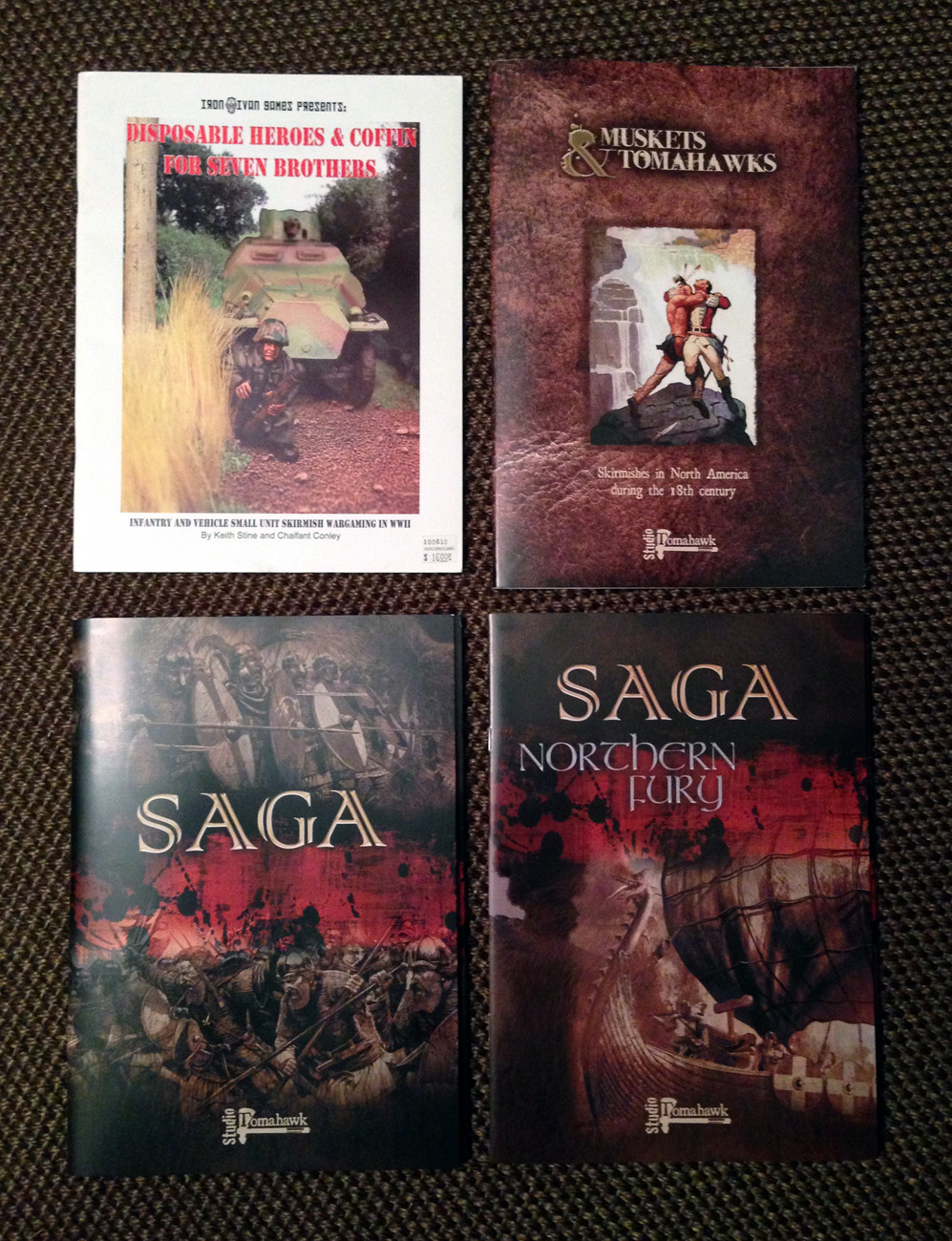
Last week at my FLGS I picked up some new rulebooks. Saga has been all the rage lately and since I love me some Dark Ages, particularly the Norman Conquest kind, I decided to give it a closer look. Since we know the French and Indian War has some appeal for me, Muskets & Tomahawks, from Studio Tomahawk, the creators of Saga, seemed a natural pick-up, too. And since I like my current French and Indian War rules of choice so much, This Very Ground by Iron Ivan Games, I bought their World War Two skirmish set, Disposable Heroes & Coffin for Seven Brothers.

So if I like This Very Ground (TVG) so much, why bother with Muskets & Tomahawks (M&T)? Shiny object - I couldn't resist. And I have an ultimate plan. . .
A campaign, of course. I want to use GMT's boardgame, Wilderness War, as the basis of the campaign. 

I have been building my 10-man units with the John Jenkins miniatures to each represent 1 Strength Point from the boardgame. TVG perfectly handles the army level battles generated by the boardgame, but there's a "frontier ravaging" sub-game that is happening simultaneously with the army level that feels like it needs a more intimate scale than the army level. Hence I keep looking at rules. . .

After reading through M&T, I think it could easily fit the bill. In fact, it reads (disclaimer: I haven't played, yet) a lot like TVG. Both games are unit-based; each unit comprised of 4 to 12 soldiers in M&T, 5 to 20 in TVG. Both games activate a unit at a time, and alternate activations. TVG has a more interesting activation system, based on Initiative and player choice; M&T is card-driven, with an option to build hands instead of relying on the draw (I like the option). Again, in both games, each unit moves, shoots and fights before another unit activates. In TVG the soldiers are required to be in a formation and all take the same action. In M&T the soldiers can do different actions, which means that some can fire while others reload, and individual figures have to be marked for reloading. TVG uses a "Volume of Fire" mechanism that allows a single marker to be used for a unit, which I like.

In both games, each combatant has 3 defining characteristics. TVG bases these characteristics on a D10, M&T on a D6. This permits TVG to differentiate unit quality with numbers to a greater extent, M&T relies a bit more on "traits."

Shooting is handled the same in both games; each figure gets a die, rolling to hit and then rolling each hit to wound. Morale tests are taken by unit each time casualties are incurred. Both games handle morale degradation with 3 levels of decreasing effectiveness.

Officers are treated as individual units in both games; unit leaders are handled differently. In M&T, each unit has a leader who by virtue of being a leader is the last casualty in the unit. In TVG, each unit has one or more leaders (non-coms) that can become casualties as part of normal combat, and their loss can have a detrimental effect on unit performance. As officer mortality was quite high in the French and Indian War, I think TVG gets this right.

TVG provides some sample scenarios that can be strung together to form a mini-campaign and encourages the reader to devise their own scenarios, while M&T provides a neat scenario-generation system. M&T also has a system for random events and for "Side Plots" that add some fun and fanciful elements into the canned scenarios.

I like M&T enough to play a few games to get the feel of it, but I am not convinced I will switch from TVG. I may just be able to switch to smaller 5-man units to get the more intimate feel I want for the "frontier war". 

I'll get to Saga and Disposable Heroes later.

See ya.