Showing posts with label Bayonets & Tomahawks. Show all posts

Monday, August 15, 2022

Battles & Brews Game


Battles & Brews 2022 is in the books, as they say, and a good time was had by all. . . at least as far as I could see. Go here to my previous post to learn more about the event, and here for a look at some of the games. I put on one game of Fistful of Lead: Bigger Battles with the selfish goal of play-testing my rules additions and unit characterizations for campaigning during the French & Indian War. In the One True Scale, of course.

The terrain was basically symmetrical so both sides had the same advantages and challenges. The scenario was a meeting engagement, and whoever held the center clearing at game's end would be the winner.


Both armies were the same size and roughly the same configurations for as clean a play-test as possible. I am also using unit sizes that correspond to the forces used in GMT Games' Bayonets and Tomahawks for use in a map-based campaign; the Irregular units are roughly one-quarter to one-third the size of Regular Brigades. All of the Irregular units are one 6-man unit and the Regulars and Provincials are 2 10-man units with a Brigade Commander. Each army then gets one overall Commander. Each unit has an integral Unit Leader with no traits (at this time) whose loss causes a negative modifier to Rally attempts.

Each Army for this game consisted of one overall Commander, One Regular Brigade of 2 10-man units with Brigade Commander (Player One); one Provincial Brigade of 2 10-man units with Brigade Commander (Player Two - the British were Regulars and the French Irregular). Player Three had two units of Irregulars; French had First Nation Warriors and the British had Rangers. Each side then had a unit of Regular Grenadiers and French Irregular Marines or British Irregular Light Infantry to assign as desired. 6 players in total!

The Irregulars came onto the table on Turn One, the British and French on opposite sides. The French Natives and Marines entered on the narrower strip of woods with the British Light Infantry and one unit of Rangers opposite.


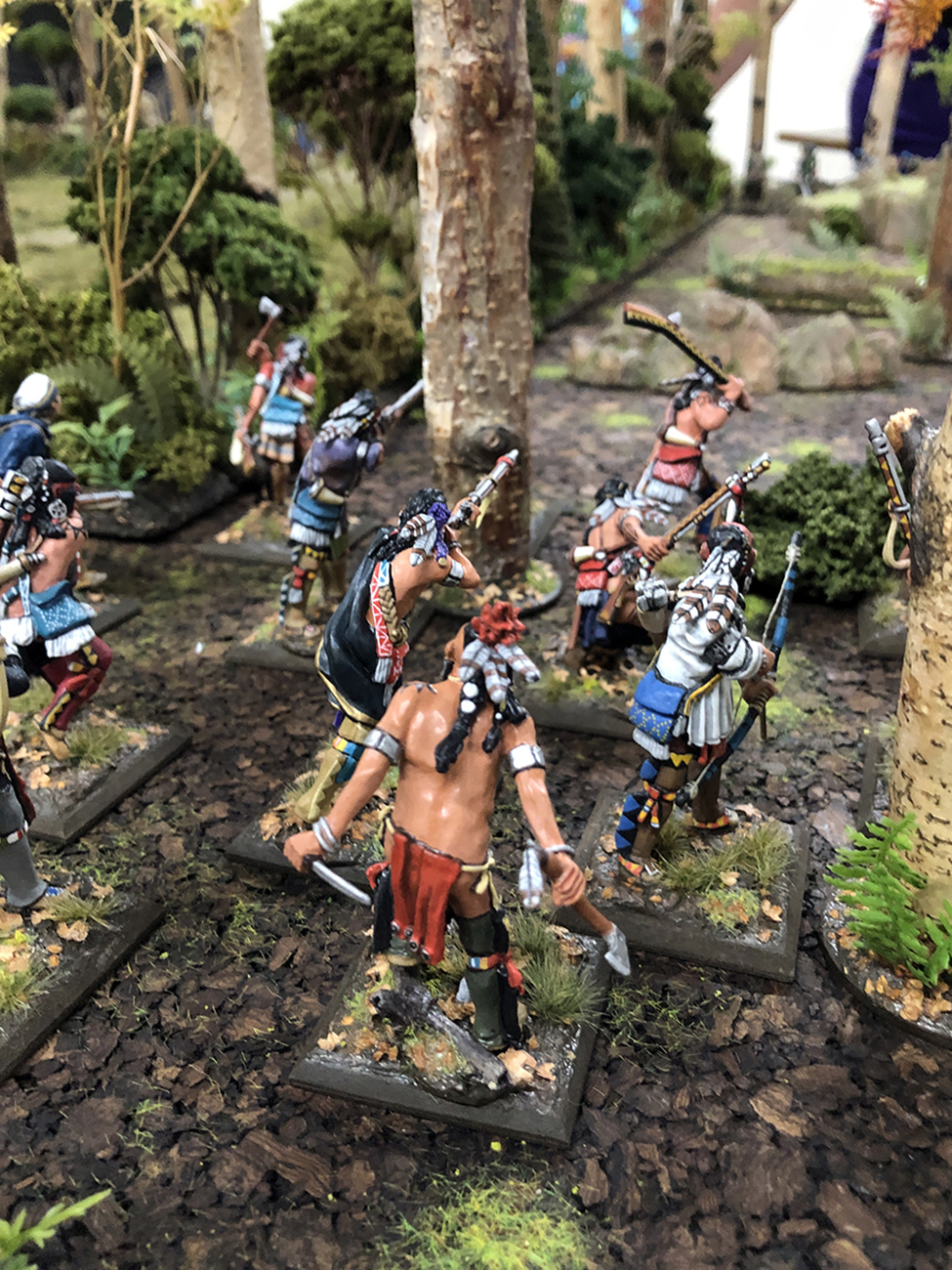
 

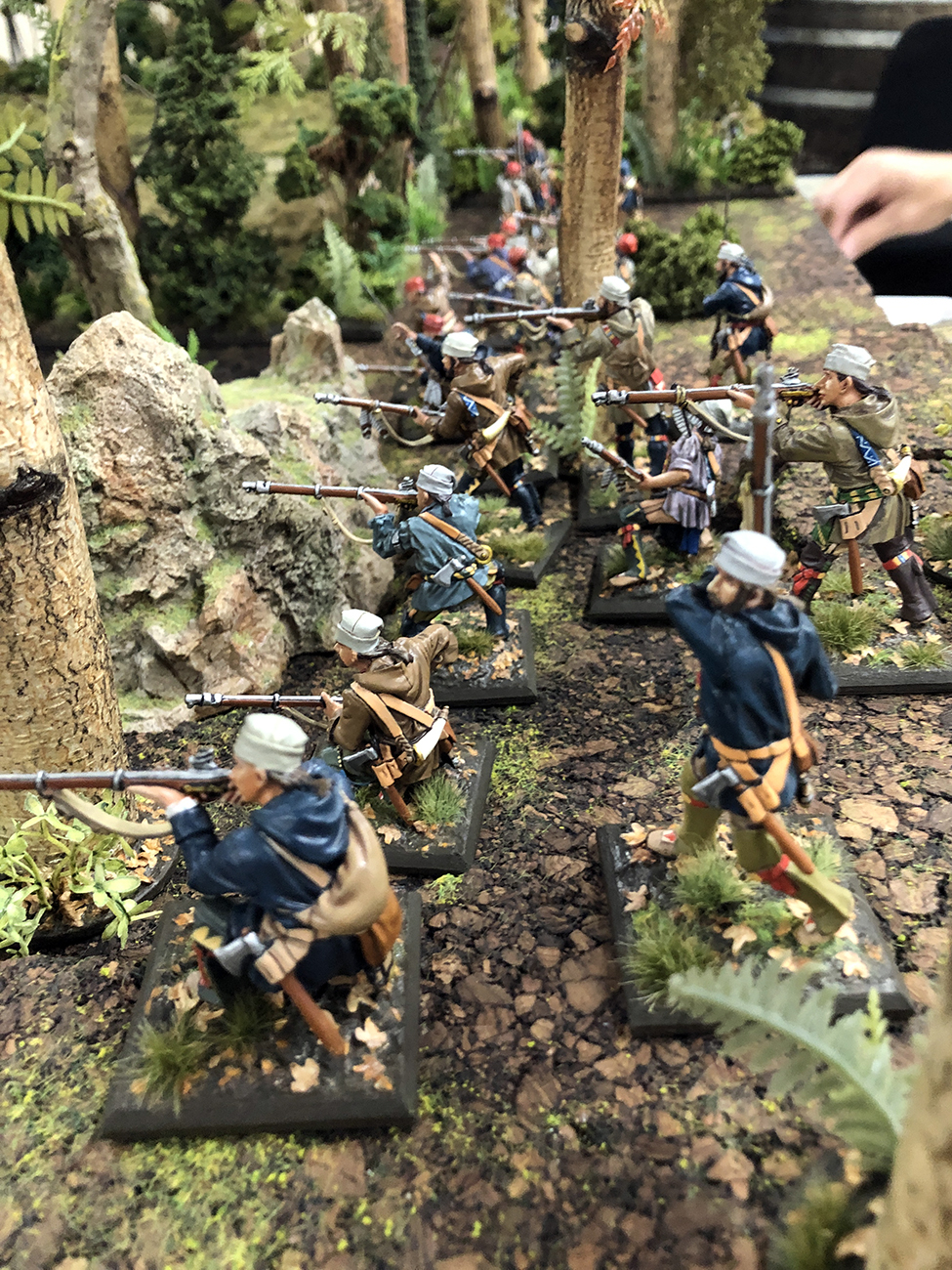
On the wider wooded flank the French Provincials faced off against the other unit of British Rangers.


On Turn Two the Regulars arrived via the road mostly, except for the British Grenadiers that entered in the woods on their left flank and one unit of the British Provincials that entered the woods on their right flank behind the Rangers.


As the Irregulars found hard cover in the woods to provide covering fire the Regulars maneuvered to sort out into firing lines in the clearing.


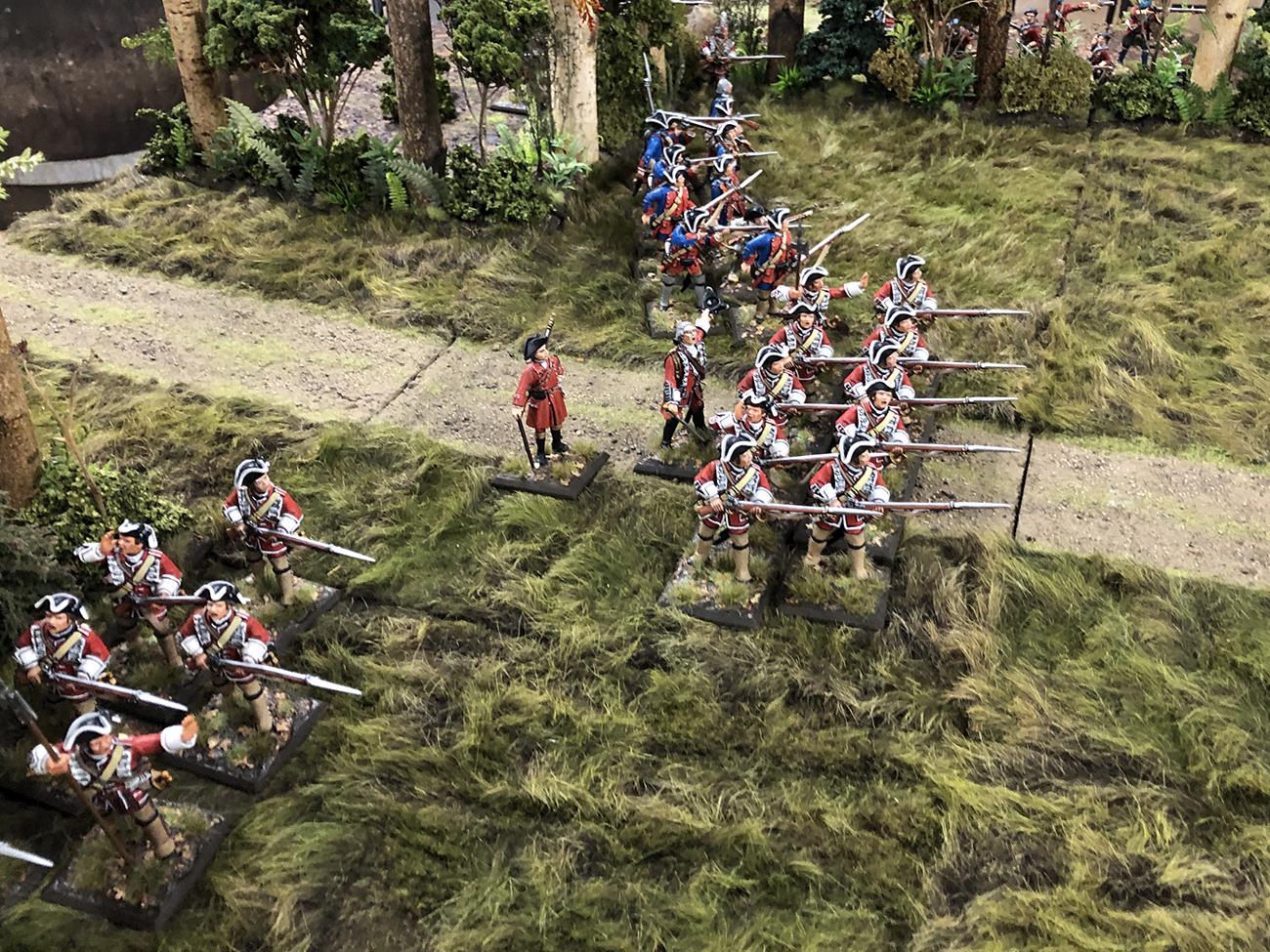


The French Regulars got their firing line organized first as the Natives charged the Rangers in the woods on their right flank, the melee throwing the Rangers out from behind their cover. The Provincials on the other flank blazed away at each other.
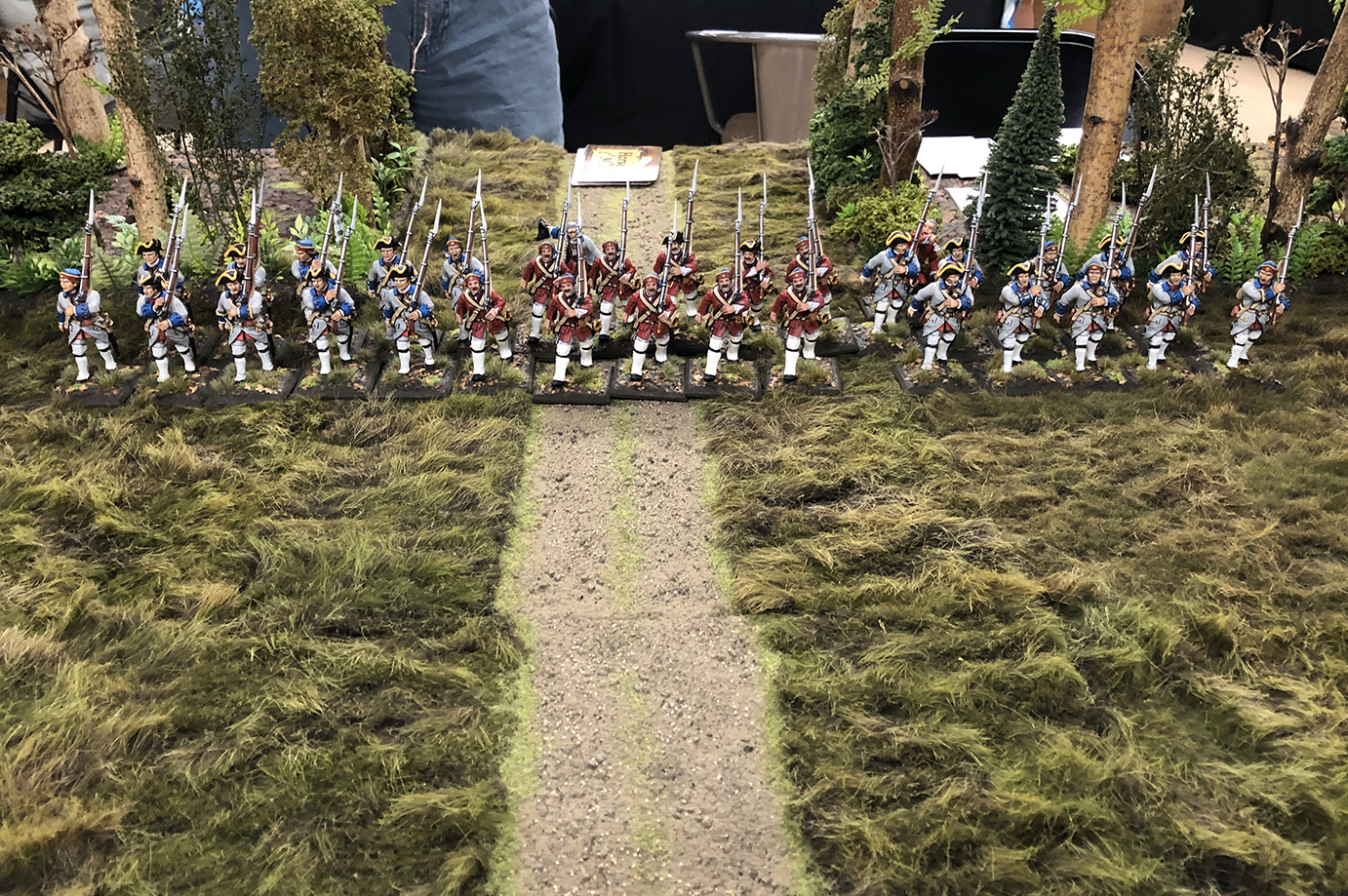

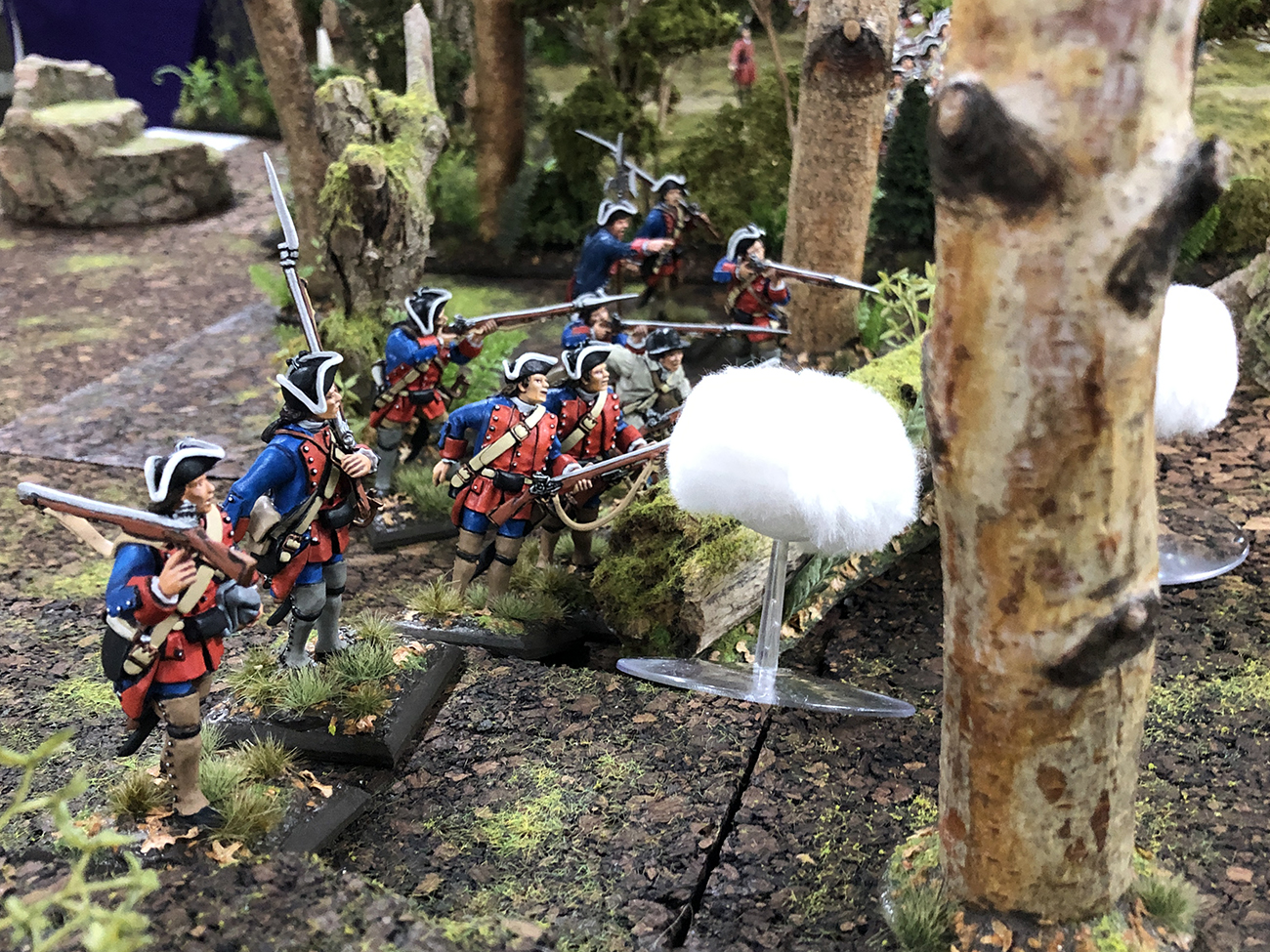


After the British Rangers fell back the Light Infantry engaged the Natives, and both sides suffered losses that caused them to retreat. The British Grenadiers moved up to the edge of the woods to provide flanking fire in the clearing and delivered the first of two devastating volleys. The French Marine Irregulars left the cover of the woods to advance through the clearing and the Grenadier volley fire killed 5 of the 6 soldiers in the unit. The second volley was delivered by the center British Regular unit and 7 of the 10 French Grenadiers went down.


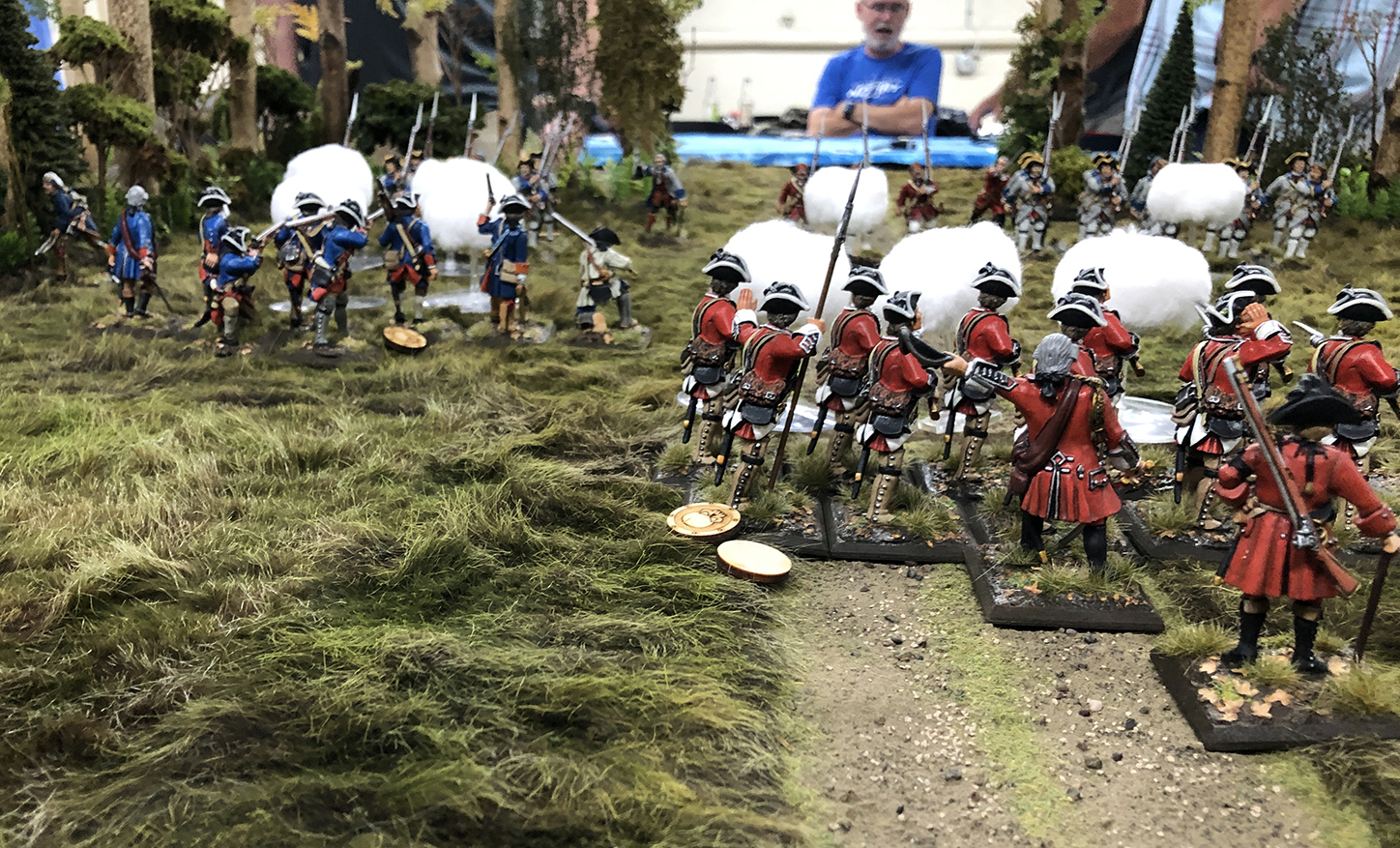


The Natives attempted to charge the British Grenadiers, but were foiled by my new Test to Charge rules. Being under half-strength and outnumbered, they failed their tests, as they should have! The British regulars were able to make good use of two "Free Reload" cards. . . and coupled with the aforementioned volleys, the French just couldn't recover and ceded the field.


I had a blast watching this game, and all the players seemed to have had fun. We had at least one player new to the Fistful of Lead system, and one even new to miniatures gaming (husband and wife, respectively)! Bigger Battles handled this genre admirably and my period adjustments worked as intended,. The dilemma of 18th Century Regular commanders seemed well represented - does one move into close musket range and risk taking a crippling First Fire or wait in the hope that you will get to deliver said crippling Fire instead? After delivering that volley will your men drive the enemy from the field at bayonet-point as ordered? I'm looking forward to more games using the Fistful rules, and experimenting with campaign adaptations.

See ya!

Tuesday, April 27, 2021

Commands & Colors


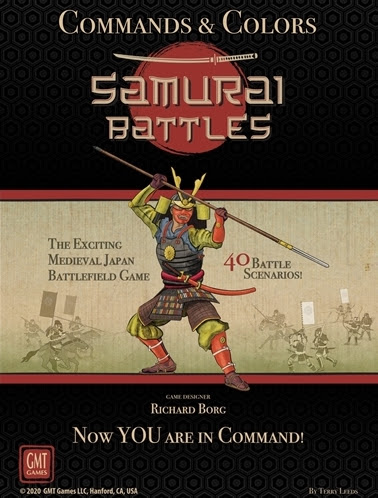
I received my copy of Commands & Colors: Samurai Battles a week ago as part of the GMT PS500 program. Got Bayonets & Tomahawks, too!

I've been a fan of the game system since the Ancients version was released. It's card-driven, but it feels like DBA to me (remember I consider that high praise), in scale and unit treatments, with the addition of rules for attrition. I have all of the Ancients supplements, plus Medieval and Red Alert (the "space combat" variant).

Of course I am converting the games to miniatures. My plan has been to use 4" hexes and 15mm miniatures mounted on 40mm wide bases for Ancients, and that may still continue to happen, but I am also now considering using 54/60mm models for at least my "favorite historical conflict," the Punic Wars. Not intuitive, I know; we lose the "mass effect" with fewer, bigger models representing each unit. I can still use 4" hexes, like I have been doing for 15mm figures, and use one model to represent each "block" in the game, so most Ancients units will consist of 3 or 4 models. Might even be able to use some of the same hex terrain for both scales with some careful planning.

Why go this route? The main driver is I have never been totally satisfied with any of the 15mm or 28mm Republican Roman models I've encountered. I really like the John Jenkins Designs models for both accuracy (I know, right?) and drama. The Gauls are stunning.

Then, one must determine in what "world" the models will live and fight, and playability is key. These models tend to be top-heavy, so either they need wider bases for added stability on uneven terrain, or the terrain needs to be very flat and even. My French & Indian War terrain and basing is a good example of the former.

Since I am more interested in playing large battles than skirmishes, terrain can be less detailed and more abstract. . . and flat. That means the bases of the models won't need to be enlarged. One thing I do want is magnetic bases, so the models will stay put in their traveling boxes. After a bit of experimentation, I found a self-adhesive magnetic tape that can be cut to the silhouette of the base edge of the model. The tape is only 1mm thick, so with a bit of paint and flocking after the fact, it won't even be noticed, and the base will visually blend with the terrain. How strong is the magnetic effect? I applied to a "left-over" French Regular as a test and he can crawl right up a metal cabinet like Spider-Man!

Basing potentially solved; on to the terrain. How flat is flat? Can't be boring. . . and we still need to represent hills. Can't have slopes, though, for the above-mentioned reasons, and for the same reasons the "tops" of the hills have to be flat.

Years ago I purchased a quantity of GHQ Terrain Maker foam hexes; I hauled some out and started making terrain. The goal was a "scrubby" Mediterranean look. I started with a sandy brown latex house paint; literally sandy as I mixed sand into the paint. This texture hides the surface look of the foam itself. I then followed that up with 3 different colors of fine green flock, held in place with sprayed coatings of diluted white glue. Multiple, soaking coats is key. The foam hexes come in 4 different "heights," providing instant flat hills.


Some other special, easily recognized terrains are needed, too. Woods, for example. I can do Woods. Again, playability is important, so I opted for a single large tree in the center of the hex that would leave enough room for the models. For the hex base I started with the same dark brown latex house paint color I use for the French & Indian War bases and layered on some brighter green flocks and "leaf litter." Here are some Woods and Clear hexes next to each other - and not every Woods hex has to have a tree.


Can't forget about the Rough/Rocky ground. I mixed a little paper mache into the latex paint and layered on some fine gravel with a little less green flock. Goal is still as flat as possible, but the look should be "rocky." A helpful feature of the foam hex is that you can actually press any high spots down into the foam after the glue dries and spray on another layer of glue.


I haven't attempted any water features yet but have a pretty good idea of how I will handle them. Here's how the terrain looks with Roman legionaries on the advance.


A little paint and flock and the bases of the models will blend right in to the terrain. I'm sure it won't surprise you to learn I have a "house rule" or two in playtest mode. And I will still be able to skirmish since the models are individually based. "Short" distance for SAGA at this scale just happens to be the width of a 4" hex. . .

See ya!