Showing posts with label Book Like. Show all posts

Sunday, September 8, 2019

Reading about Romans and Prepping for Recruits

I recently read three new-ish books on Ancient Rome (mostly) I really enjoyed. First up is Early Roman Warfare: From the Regal Period to the First Punic War.

 From Amazon:

Here Dr Jeremy Armstrong traces the development of Rome's military might from its earliest discernible origins down to the First Punic War. He shows how her armies evolved from ad-hoc forces of warriors organized along clan lines and assembled for the city's survival, to the sophisticated organization of the legions that went on to dominate all of Italy and then (after the period covered) the entire Mediterranean world.

Makes a good case for a little "warband-type" skirmishing a la Warlord's new SPQR game.

Next up is Swords and Cinema: Hollywood vs the Reality of Ancient Warfare


Again from Amazon:

The battles and sieges of the Classical world have been a rich source of inspiration to film makers since the beginning of cinema and the 60s and 70s saw the golden age of the ‘swords and sandals’ epic, with films such as Spartacus. Ridley Scott’s Gladiator led a modern revival that has continued with the release of films like 300, The Eagle and Centurion and HBO’s mini-series Rome.

While Hollywood interpretations of Classical battle continue to spark interest in ancient warfare, to casual viewers and serious enthusiasts alike they also spark a host of questions about authenticity. What does Hollywood get right and wrong about weapons, organization, tactics and the experience of combat? Did the Spartans really fight clad only in their underpants and did the Persians have mysterious, silver-masked assassins in their armies? This original book discusses the merits of battle scenes in selected movies and along the way gives the reader an interesting overview of ancient battle. It should appeal to the serious student of ancient warfare, movie buffs and everyone in between.


Was fun to hear someone else echo all the same complaints of "wrong helmets!" and embellished history that I've made while watching historical movies (just ask my daughters!)

Last up is a book I thoroughly enjoyed: Legion versus Phalanx: The Epic Struggle for Infantry Supremacy in the Ancient World.

From Amazon:

From the time of Ancient Sumeria, the heavy infantry phalanx dominated the battlefield. Armed with spears or pikes, standing shoulder to shoulder, and with overlapping shields, they presented an impenetrable wall of wood and metal to the enemy. It was the phalanx that allowed Greece to become the dominant power in the Western world. That is, until the Romans developed the legion and cracked the phalanx.

In Legion versus Phalanx Cole weighs the two fighting forces against each other. Covering the period in which the legion and phalanx clashed (280--168 BC), he looks at each formation in detail--delving into their tactics, arms, and equipment, organization and the deployment. It then examines six key battles in which legion battled phalanx: Heraclea (280 BC), Asculum (279 BC), Beneventum (275 BC), Cynoscephalae (197 BC), Magnesia (190 BC), and Pydna (168 BC)--battles that determined the fate of the ancient world. Drawing on original primary sources, Myke Cole presents a highly detailed but lively history of this defining clash of military formations.

Mr. Cole does an outstanding job of bringing these epic clashes to life, describing the sights and sounds and smells - all of the experiences of the soldiers on the ground. Recommended!

Recruits is coming up the end of this month! Since I missed last year due to knee surgeries, I felt compelled to bring some new terrain this year. . . here's a look at an early stage.

 
If you want to see the completed models in action, you can either come play with us at Recruits or wait for the AAR here. We'll be playing a scenario called Revenge. . . 1759-style! using Fistful of Lead: Horse & Musket from Wiley Games. Hope to see you there!


Saturday, March 3, 2018

Book Like and Little Julie


And so we return to our regularly-scheduled programming. . .

I just finished Hodges' Scout, described thus on Amazon:

In September 1756, fifty American soldiers set off on a routine reconnaissance near Lake George, determined to safeguard the upper reaches of the New York colony. Caught in a devastating ambush by French and native warriors, only a handful of colonials made it back alive. Toward the end of the French and Indian War, another group of survivors, long feared dead, returned home, having endured years of grim captivity among the native and French inhabitants of Canada.

Pieced together from archival records, period correspondence, and official reports, Hodges’ Scout relates the riveting tale of young colonists who were tragically caught up in a war they barely understood. Len Travers brings history to life by describing the variety of motives that led men to enlist in the campaign and the methods and means they used to do battle. He also reveals what the soldiers wore, the illnesses they experienced, the terror and confusion of combat, and the bitter hardships of captivity in alien lands. His remarkable research brings human experiences alive, giving us a rare, full-color view of the French and Indian War―the first true world war.

Mr. Travers accounts for nearly every member of the 50-man company ambushed on that September day more than 250 years ago. The stories of Indian captivity endured were harrowing, but I had no idea that there was a system of virtual slavery in place in Canada for captured Anglo soldiers. Many of them were shipped overseas and exchanged for French POW's held in England, so ended up thousands of miles from home with little means and even less hope of returning to America.

Staying with the F&IW theme, here is a recent release from John Jenkins Designs, "Little Julie." 

 
A pretty little girl. . . but something doesn't seem quite right. . .
 

Ahhh. . . little Julie has lived on the frontier all her life and knows how to handle those pesky War Parties. . .


Monday, May 29, 2017

Memorial Day, Martian Legion and Two Hour Wargames


Jack is no longer with us, but he wants to make sure we remember to thank our veterans for their service and their sacrifices on this Memorial Day. I think those of us who turn history into games have a special responsibility to remember those who made the history in the first place.

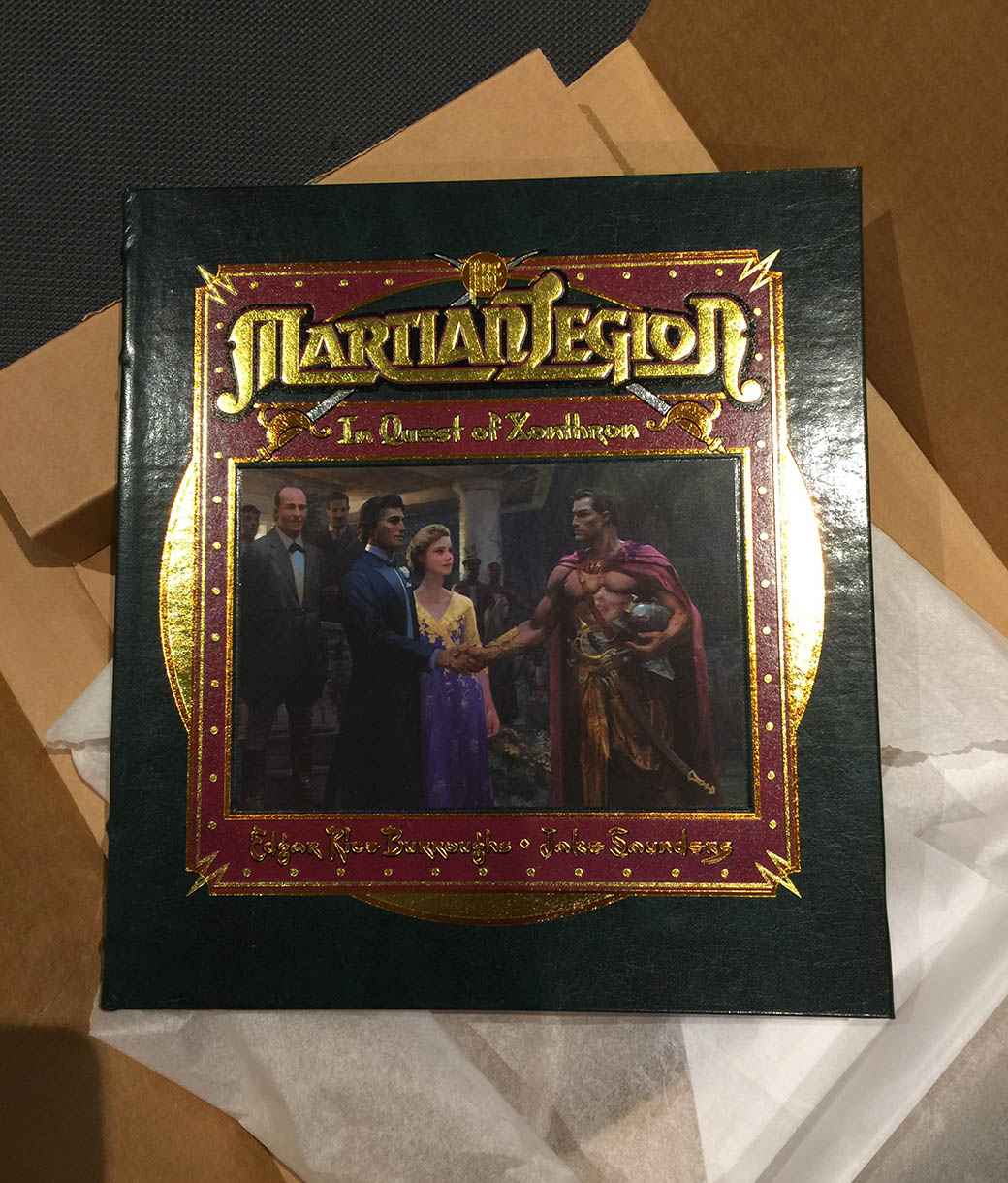
Next topic: there's a book called The Martian Legion that I was able to resist for a long time. But I caved; it's about John Carter and Barsoom, after all. And every other character ERB ever created. . . and just about every other Pulp character ever created. It is a big, beautiful over-priced book that is supposed to be a big, beautiful mash-up of ERB and The Pulps. I have a feeling I'll be underwhelmed by the big, beautiful mash-up but the book itself is big and beautiful and the paintings by Craig Mullins are EXACTLY how I picture Barsoom.

The unveiling. . .


It is beautiful. . .

Next Topic: Two Hour Wargames. They are not for everybody, but I am a fan of the "reaction" mechanics and the way that you are forced to manage the battle as opposed to commanding it. The only character you are ever in complete control of is YOU, no matter what set of rules you are playing. . . or genre or level of command. AND you can play solo. Really solo, against the game rather than just playing both sides "honestly." AND the "fog of war" is real, due to the game mechanics. Watching the movie Midway this morning reminded me just how critical that "fog" is to a more "realistic" impression of history in our games.

So I am going to spend some time playing through some THW rules for the French and Indian War and World War 2, and eventually Sci-Fi and Pulp (Barsoom, again?). Not exclusively, but seriously.


See ya!
 

Sunday, May 21, 2017

Stupid Human Tricks, Colonial-Style. . .


While reading A Wilderness of Miseries by John E. Ferling, I came across this passage in a chapter about typical military discipline during the American Revolutionary War that surprised me:

"Some of the orders were designed to protect the troops from one another, to prevent accidental or deliberate injuries; for instance at the outset of the war officers were notified to fine soldiers around Boston who tried to catch British-fired cannon balls before they stopped bouncing."

Who has to be told, under threat of fine, not to catch a cannon ball?

Sunday, April 23, 2017

Fiinally Finished the Beast. . .


Well, it took a while. . . partly because I don't plow through one book at a time. . . and partly because the Butterfly Brain gets distracted by all sorts of topics both historical and contemporary. . . and partly because An Invincible Beast is a bit of a dense read. I'm a big fan of Dr. Matthew's combination of research into primary sources with physical recreation, ballistics testing and re-enactment, but it is not exactly summer beach-reading.

On page 399, Dr. Matthew summarizes (sorta):

Diodorus declared that 'Macedonian spears had conquered Asia and Europe.' The organization of of Hellenistic pike formations onto units and sub-units, combined with an elaborate and symmetrically distributed command structure, made the pike-phalanx a very ordered instrument of war - one that was mutually supporting, offensively and defensively strong, and adaptable to the varied tactical requirements of the ancient battlefield. Phalangite formations, for example, could be deployed to different depths, with the most common being that of sixteen ranks deep, but could also be arranged in deeper or shallower configurations depending upon the terrain, the size of the opposing force, the decisions of those in command and the situation of the day.

It seems that pike phalanxes were in a more open order than usually depicted, to make room for 5 ranks of deployed pikes, and the great length of the pikes were generally used to hold the opposing forces at bay. 

This allowed the pike-phalanx to effectively pin an enemy formation in place as part of the standard tactic of pike-phalanx combat - that of the hammer and anvil. Across the entire Hellenistic Period this tactic of using the pike-phalanx in the center to hold an enemy formation (or part thereof) in position while other, more mobile troops swept around to strike from the flanks remained unchanged. This in itself demonstrates the integral part that the pike-phalanx played in the conflicts of this time period.

While the functionality of the phalangite remained little changed cross the Hellenistic Period, the tools and strategies of war constantly developed in attempts to overcome the advantages held by the pike-phalanx, particularly during the time of the Successors following the death of Alexander the Great in 323BC when pike-phalanx fought pike-phalanx and a decisive tactical advantage of some kind was required to secure victory. Consequently the sarissa (pike) itself became longer to outreach an enemy armed in similar fashion, and beasts such as elephants were more regularly employed to try and smash an opposing formation apart. Many of these tactical 'experiments' met with mixed results; the pike could only be increased in length until a point was reached where it was almost impossible to wield, and contingents of elephants could be countered with other elephants, a solid wall of pikes, missile troops or other measures. As a result, the phalangite, and the pike-phalanx, retained its position of supremacy on the battlefield.

Yet for all its advantages, the pike-phalanx did have its limitations. This was mainly the potential for gaps to open in the line - due in part to the phalanx being comprised of semi-independent units and sub-units. If such gaps could be exploited by a more mobile opponent, one who could get inside the rows of projecting pikes, this was when the pike-phalanx was most vulnerable as the long sarissa made the phalangite a very ineffective individual combatant, and larger units were incapable of turning to meet threats from the sides once their pikes had been lowered. It was the ability of the Roman legionaries to take advantage of this inherent weakness in the Hellenistic pike-phalanx which ultimately led to the formation's demise.

 Sounds like DBA to me : )

If you want to know how the Romans defeated the pike-phalanx, or exactly how it was organized, or when and where it was first developed, and by who, you'll have to read the book.

I stumbled onto another book when looking up the author John Ferling, some of whose work about the Revolutionary War I have read - but I was not familiar with A Wilderness of Miseries, which is about the "warriors" of colonial America. Its sociological angle immediately drew me in. I AM "plowing" through this one!


I'll have some more F&IW terrain to show soon, as well as some thoughts on rules for the period I am considering.

See ya!


Tuesday, July 19, 2016

What Am I Reading Now?


My Butterfly Brain is apparent in some of the books I've added to my reading list. I'm really looking forward to wading into Dr. Matthew's hefty book on the Macedonian pike phalanx. Also of "ancient" interest are new books on Rome and Syracusan tyrants, as well as a new set of fast-play wargame rules for classical naval battles from Osprey Publishing.


Here are a couple of new books on the French and Indian War. I highly recommend the new Osprey COMBAT  - it directly inspired my recent Black Powder game of La Belle Famille.


 Osprey just released a new Campaign book on the Gempei War, of course by Dr. Turnbull.


The recent wargaming "glossies" have relevant content, too. This one has a review of The Baron's Fistful of Lead rules by Lion and Dragon Rampant author Daniel Mersey, as well as a mention of his most excellent blog.


All have reviews of the new black-powder-era skirmish rules Sharp Practice 2 from Too Fat Lardies, which have a section devoted to the French and Indian War. The Norman Conquest issue features some Lion Rampant and Hail Caesar! articles to help scratch that Dark Ages itch.


See ya!


Friday, May 27, 2016

Next up: Warlord US Open Games Day


Two weekends ago I moved a pile of mulch, the equivalent of 250 bags, from our driveway to our various plant beds, one wheelbarrow-full at a time. I rewarded myself the following weekend by prepping the bases of 60 more French and British soldiers, in lieu of any more yard work, as the Great 54mm Re-Basing continues. I know; to each our own motivations.

I am re-basing another 60 soldiers in preparation for the Warlord: Open Games Day in Oklahoma City the weekend of June 17th where I'll be taking my F&IW project to play some Black Powder, Warlord's horse and musket rules. Black Powder is more of a "big battle" ruleset than skirmish-level, so I think it important to feature some straight linear firefighting between the European Regulars as well as the more expected colonial irregulars.

I found an appropriate scenario in a new Osprey book I just bought (and recommend!):


 As described within, the battle at La Belle Famille is a meeting engagement in a clearing between two predominately Regular forces and their Native allies. In the actual battle, the British arrive before the French and set an ambush from which the French can't recover. I am changing the chronology a bit so that both forces start with light troops on the table screening the near simultaneous arrival of the Regulars on opposite ends of the road. The start of the game will look something like this:


I don't have a lot of hands-on experience with Black Powder, so The Baron has agreed to be my Co-GM for the Day. Thanks, man. Road trip!

Come see us at Warlord: Open Games Day in Oklahoma City the weekend of June 17th!


Tuesday, November 24, 2015

Brazen Chariots


I had heard somewhere that Brazen Chariots was an amazing book about armored warfare in North Africa during World War 2. Some time later I found a used hardback copy of the book and put it on the shelf, to await the appropriate opening in the reading queue. I pulled it down last week on a whim and, as it is only 240 pages long, ended up tearing through it in less than a week.

Amazon describes it thus:

"Unquestionably the finest narrative of tank warfare to come out of World War II."
Los Angeles Times

A tank officer's story of the desert war in North Africa, "Brazen Chariots" is one of the most widely praised war books ever published. Major Robert Crisp recounts Operation Crusader, the great tank battle waged against Rommel's Afrika Korps on the borders of Egypt.

The story covers just a little more than 2 weeks of war in the desert, but it is exceptionally well written; dry (pun intentional), witty, raw and at times, heart breaking. I found myself stopping to admire turns of phrase and wondering about a man who could write with such frankness and eloquence. I was not surprised to learn Robert Crisp worked as a journalist; his story beyond the war can be found in part, here.

I highly recommend you read Brazen Chariots, and be prepared to want more when the book abruptly ends!

See ya!


Sunday, November 8, 2015

Hannibal: A Hellenistic Life

Project-wise I don't have much progress to show. . . spray-varnishing minis and re-building woodland terrain does not make for dramatic documentation, so I'll share a "book like" instead. I just finished Hannibal: A Hellenistic Life, by Eve McDonald. Amazon describes it thus:

Hannibal lived a life of incredible feats of daring and survival, massive military engagements, and ultimate defeat. A citizen of Carthage and military commander in Punic Spain, he famously marched his war elephants and huge army over the Alps into Rome’s own heartland to fight the Second Punic War. Yet the Romans were the ultimate victors. They eventually captured and destroyed Carthage, and thus it was they who wrote the legend of Hannibal: a brilliant and worthy enemy whose defeat represented military glory for Rome.

In this groundbreaking biography Eve MacDonald expands the memory of Hannibal beyond his military feats and tactics. She considers him in the wider context of the society and vibrant culture of Carthage which shaped him and his family, employing archaeological findings and documentary sources not only from Rome but also the wider Mediterranean world of the third century B.C. MacDonald also analyzes Hannibal’s legend over the millennia, exploring how statuary, Jacobean tragedy, opera, nineteenth-century fiction, and other depictions illuminate the character of one of the most fascinating military personalities in all of history.


My wife asked me, when she saw me reading Hannibal, "Are you reading the same book about Hannibal, AGAIN?" Well. . . sorta. We only have so much information on a man that lived over 2,000 years ago. That said, Hannibal is a solid biography with copious notes and an extensive bibliography. It's focus is more socio-political than military, with some emphasis on "myth management" and use of propaganda, and places Hannibal and his Roman opponents squarely within a thoroughly Hellenistic Mediterranean political arena. 

From a "wargamer" point of view, then, this book is way more about "strategy" than tactics; in fact there is not a single battle diagram and battle descriptions are taken mostly from the primary sources and used to provide context for the narrative. Still, an interesting read.

See ya! 

Sunday, October 4, 2015

JoAnn Score and Book Likes


Score! Between half-off on "fall foliage" and a coupon for 25% off my entire purchase. . .


I scored enough pre-painted plastic foliage to dress up a table full of trees for only $9.00! The pre-painted part is super-sweet - I haven't seen these colors before - even a bit of "Fall creeping in" hues. Some Tamiya Flat-coat and we're in the forest-building business again.

On to the Book Likes. First up by Chris Webber: Gods of Battle: The Thracians at War, 1500 BC - 150 AD.


 Amazon describes it:

Herodotus described the Thracians (who inhabited what is now roughly modern Bulgaria, Romania, the European part of Turkey and northern Greece) as the most numerous nation of all - apart from the Indians - and said that they would be the most powerful of all nations if they didn't enjoy fighting each other so much. There may have been a million Thracians, divided among as many as 40 tribes.
Ancient writers were hard put to decide which of the Thracian tribes was the most valiant; they were employed as mercenaries by all the great Mediterranean civilizations. Thrace had the potential to field huge numbers of troops, and the Greeks and Romans lived in fear of a dark Thracian cloud descending from the north, devastating civilization in the Balkans. The Thracian way of warfare had a huge influence on Classical Greek and Hellenistic warfare. After Thrace was conquered by the Romans, the Thracians provided a ready source of tough auxiliaries to the Roman army. Chris Webber gives an overview of Thracian history and culture, but focuses predominantly on their warfare and weapons. The latest archaeological finds are used to give the most detailed and accurate picture yet of their arms, armor and costume. He identifies and differentiates the many different tribes, showing that their weapons and tactics varied. The resulting study should be welcomed by anyone interested in the archaeology and history of the region or in classical warfare as a whole.

This is a great "wargamer" read. Lots of primary source and archaeology used to describe how the Thracians fought and how they looked doing it. Recommended without reservation.

Next up, by Dr. Phil Sabin: Simulating War: Studying Conflict through Simulation Games.  


 Again, per Amazon:

Over the past fifty years, many thousands of conflict simulations have been published that bring the dynamics of past and possible future wars to life.
In this book, Philip Sabin explores the theory and practice of conflict simulation as a topic in its own right, based on his thirty years of experience in designing wargames and using them in teaching. Simulating War sets conflict simulation in its proper context alongside more familiar techniques such as game theory and operational analysis. It explains in detail the analytical and modelling techniques involved, and it teaches you how to design your own simulations of conflicts of your choice. The book provides eight simple illustrative simulations of specific historical conflicts, complete with rules, maps and counters.
Simulating War is essential reading for all recreational or professional simulation gamers, and for anyone who is interested in modelling war, from teachers and students to military officers.

This is an interesting read if the theory of game design interests you. The appenidx on probability and statistics using the D6 was useful for me. I might have named this "Designing Wargames for Non-Wargamers." I recommend it, but it's a dry read.

See ya!

Tuesday, March 31, 2015

A Storm of Spears


I just finished a compelling and enlightening book: A Storm of Spears: Understanding the Greek Hoplite At War. If you have any interest in the manner in which ancient warriors fought each other, this book may be a required read. Amazon describes it thus: 

The backbone of classical Greek armies was the phalanx of heavily armored spearmen, or hoplites. These were the soldiers that defied the might of Persia at Marathon, Thermopylae and Plataea and, more often, fought each other in the countless battles of the Greek city-states. For around two centuries they were the dominant soldiers of the Classical world, in great demand as mercenaries throughout the Mediterranean and Middle East. Yet, despite the battle descriptions of Herodotus, Thucydides, Xenophon etc, and copious evidence of Greek art and archaeology, there are still many aspects of hoplite warfare that are little understood or the subject of fierce academic debate.

Christopher Matthew's groundbreaking reassessment combines rigorous analysis of the literary and archaeological evidence with the new disciplines of reconstructive archaeology, re-enactment and ballistic science. He focuses meticulously on the details of the equipment, tactics and capabilities of the individual hoplites. In so doing he challenges some long-established assumptions. For example, despite a couple of centuries of study of the hoplites portrayed in Greek vase paintings, Matthew manages to glean from them some startlingly fresh insights into how hoplites wielded their spears.

These findings are supported by practical testing with his own replica hoplite panoply and the experiences of a group of dedicated re-enactors. He also tackles such questions as the protective properties of hoplite shields and armor and the much-vexed debate on the exact nature of the 'othismos', the climax of phalanx-on-phalanx clashes. This is an innovative and refreshing reassessment of one of the most important kinds of troops in ancient warfare, sure to make a genuine contribution to the state of knowledge.

Christopher Matthew has just completed his doctoral thesis on hoplite warfare at MacQuarie University in Sydney, where one of his assessors has said he 'singlehandedly advanced the whole field'. He has also been invited to lecture on the subject at other Australian universities. This book, closely based on his doctoral thesis, will be his first, although he has already had several articles published in academic journals. 'He is currently working on a new translation of Aelian's work on tactics and co-editing (with Dr Matthew Trundle) Beyond the Gates of Fire: New Perspectives on the Battle of Thermopylae, both of which will be published by Pen & Sword.


“…groundbreaking reassessment combines rigorous analysis of literary and archaeological evidence with the new disciplines of reconstructive archaeology, reenactment and ballistic science…painstakingly examines and reconstructs details of hoplites’ equipment, tactics and capabilities…Both experts and laymen can gain fresh knowledge from reading this well written analysis of ancient warfare…”
Toy Soldier and Model Figure Magazine


"The author has taken a fresh look at old evidence of ancient Greek writers and artists and coupled that with modern research. . . . In the process, some interesting and groundbreaking developments emerge that shed new light on just what the ancient writers meant and how much artistic license was used in creating the vase paintings we envision when we think of this period of history. This is a serious work of intellectual pursuit."—IPMS/USA


"…indispensable reading for anyone interested in ancient warfare."
NYMAS

"...practical and thought provoking...a well-argued, well-written and well-illustrated chance to think about the problem anew."
The Historian 


I recommend this book unreservedly. It changed the way I view Hoplite warfare. As a martial artist and product development professional I appreciate Dr. Matthew's use of re-enactment and applied science to reach his conclusions.

So what "game effect" does all this theorizing make? I don't think it changes the way Hoplites should be represented in any of the rulesets I currently use. It may effect the miniatures chosen to represent said Hoplites. For instance, according to Dr. Matthews my favorite beloved Wargames Foundry Hoplites are using an overhand grip to throw a javelin. . .


. . . since spear-fighting while in the phalanx was done underhanded. . .


I have a lot of these overhand-spear-wielding figures in the Lead Mountain. I sure do like them, even though I now believe they don't accurately depict Hoplites in the Phalanx.

Hmmm. Vive artistic license!

See ya!

Sunday, February 1, 2015

HOTTs and Poland


So. . . not HOTTs in Poland. . . The Poland part comes later on. Bruce and I played three games of HOTTs last weekend. I played with my Undead, Bruce trotted out a different army in each of the three games. I played with 8 Hordes, a Behemoth, 2 Flyers, A Hero (vampires) and a Magician General. I defended in the first game.


The Sea Kings brought Riders, Airboats, Flyers and A Hero General. We both lined up fairly conservatively, holding our Flyers in reserve. The Riders waded into the Hordes while the Airboats threatened the Undead left flank.


The left flank turned into a scrum. An Airboat went down to a Hero then the Sea King Hero General picked a fight with the Vampires and lost. . . so Game One goes to the Undead.


For Game Two Bruce defended with the Macedonians: Shooters, Spears, Riders, Behemoth, Warbands and Hero General, of course.


And then, suddenly, as the armies are closing, the Macedonian Hero General is ensorceled. Game Over! The "hole" in the Macedonian line is where the Hero was. . .


Since it was over so quickly, we decided to play the game out. With the General gone, all of the Macedonian moves cost an extra pip. The Hordes held on long enough to allow the Undead Behemoth to kill its Macedonian counterpart, then finish off the Warbands for the "official" win.


Barbarians turned up for Game Three. Magician General, two Heroes and Warbands. A scary number of Heroes.


I lost my Hero to one of the Barbarian Heroes. Though I was able to ensorcle one of the Barbarian Heroes and play for time, the other Hero shrugged off 3 magical attacks as it chased down the Undead Magician General for the win. The Warbands never even got into contact!


So what about Poland? I just finished reading Poland by James A. Michener. Not a new book; my mother-in-law recommended it - strongly - citing my Polish ancestry. Amazon describes it thus:

In this sweeping novel, James A. Michener chronicles eight tumultuous centuries as three Polish families live out their destinies. The Counts Lubonski, the petty nobles Bukowksi, and the peasants Buk are at some times fiercely united, at others tragically divided. With an inspiring tradition of resistance to brutal invaders, from the barbarians to the Nazis, and a heritage of pride that burns through eras of romantic passion and courageous solidarity, their common story reaches a breathtaking culmination in the historic showdown between the ruthless Communists and rebellious farmers of the modern age. Like the heroic land that is its subject, Poland teems with vivid events, unforgettable characters, and the unfolding drama of an entire nation.


Praise for Poland
 
“Engrossing . . . a page-turner in the grand Michener tradition.”—The Washington Post
 
“A Michener epic is far more than a bedtime reader, it’s an experience. Poland is a monumental effort, a magnificent guide to a better understanding of the country’s tribulations.”—Chicago Tribune
 
“Stunning . . . an unmatched overview of Polish history . . . The families themselves come very much alive, and through them, Poland itself.”—USA Today
 
“A titanic documentary novel.”—The Wall Street Journal


I learned a lot. For instance, I didn't know anything about the Russian attacks of 1920. Mr. Michener does a great job of creating characters you can really care about. . . and so many of them meet tragic ends. Quite a read - I recommend it, too.

See ya!