Showing posts with label Too Fat Lardies. Show all posts

Sunday, April 18, 2021

How did I miss this?


The second edition of This Very Ground - now subtitled Victory or Death - was released in a Kickstarter last year by Brigade Games and the original author, Keith Stine, and I just found out about it! Don't know how I missed it, though there seemed to be relatively little fanfare around it. This Very Ground was the set of rules that started my gaming journey in the French and Indian War. And it has been a journey.

I lived in the Twin Cities area from 1996 to 2001, and then moved to Tulsa, OK for work. I traveled some as part of my duties and on a trip to Minneapolis I had an opportunity to revisit an old haunt, our FLGS, The Source. It was on this trip that I purchased This Very Ground after a quick perusal in the store. I had to cross the I-35 bridge afterward, and later that afternoon while sitting in the hotel bar, I saw on the CNN national broadcast that the bridge had collapsed! Wasn't actually a "close call" as I had crossed it about 2 hours prior to its collapse, but it was a fluke that I was in the city at all.

The games in the early posts of this blog were all played with This Very Ground, a fun set of rules with innovative approaches to alternating unit activation and "volume of fire" representation and reloading. The use of D10s and percentile morale mechanics made it scalable, too; unit sizes from 5 to 25 or more figures were easily managed.

So why did I move to another set of rules? I eventually found the morale system to be really ineffectual, and Officers didn't do much other than rally off Unit Disruptions, which happened so frequently in my experience that it had little effect on the game overall. But the rest of the game was elegant, mechanically consistent, had good period flavor and was fun to play.

Lo and behold, these are the two areas that received the most attention in Victory or Death! The movement, firing and formation mechanics are basically intact from the original edition, but the command and morale systems got a thorough revamp. Activation is still alternating, but Officers use Command Points to Activate Units and effect Unit performance with a few appropriate Commands. Morale still uses Disruptions as the main "control" lever, but now Officers, and even the Units themselves, have more options and responsibilities for managing them.

One aspect of the original rules I really liked was the Testing to Charge mechanic, and how hard it was to actually get into a Melee, and that once a Melee was initiated, it was a one-turn fight to the death. That mechanic has been modified - and may not have been simplified - but it is still in Victory or Death.

Like all the other "black powder" rule sets we've seen of late, the focus of Victory or Death has been expanded beyond the French and Indian War, but has been limited to conflicts in North America. Rules and army lists are provided for King Philip's War, French & Indian War, American War for Independence and the War of 1812.

All of the rules that were released separately after the first edition covering Cavalry, Cannons & Boats are now collected in Victory or Death and updated to the new mechanics where needed. No additional volumes to buy!

The one thing I find lacking is a unit deployment system. There are 4 scenarios included - one for each of the 4 conflicts mentioned previously - and you can extrapolate a basic deployment system from the rules in all four, but deployment is so key to a game's play I find this a big miss. Again, the deployment system from Sharp Practice 2 might have to be borrowed. 

And the caveat: I haven't played This Very Ground: Victory or Death yet, but am really looking forward to putting "the old friend" on the table.

While we're on the subject of deployment, another of the Too Fat Lardies' (with Reisswitz Press) rules for WW2 deserve a mention.


The Patrol rules are really fun and create a real sense of the "fog of war." Unfortunately for me, they are aimed - as usual - at post-Normandy combat, so I probably won't even try 'em out until they release rules for the Western Desert.

Lastly - and certainly not "least" - I got my second CoVid vaccination shot! Hopefully that means a facemask-to-facemask game in May or June. Bring on "the normal."

See ya.

Monday, July 6, 2020

Call Out the Militia!


I completed 3 units of 10 British Colonial Militia this July Fourth weekend. I hope my fellow Americans practiced "Safe Celebrating," and perhaps even took a little time to contemplate what could be the real moment for meaningful societal change that we may be. . . yeah. Sigh. So, as I was saying, three new units of Militia are ready to defend the Colonies. The first unit is shown above.

Here's Militia Unit #2:


The third unit is the most desperately called-out, including even women and children!


"I ain't your scout. And we sure ain't no damn militia."


Ahhhh. . . makes we want to watch the movie AGAIN!

Switching genres, Too Fat Lardies released their new Ancient-era small-unit skirmish rules, Infamy, Infamy! which uses their Sharp Practice 2 engine. Infamy! focuses on Late Republican and Early Imperial Roman conflicts with their "barbarian" neighbors: Gauls, Britons and Germans, etc. The Lardies are promising a Punic Wars-era supplement soon, so of course I have to check it out. I'm reading the advance PDF now. . .


See ya. . . sometime.


Monday, April 20, 2020

So What's New?


Well, I'm working more hours than I do normally, so I have no great stories about all the hobby projects I'm finally getting completed. . . Not playing any games, so the basing goes on. Above is a photo of the British Grenadiers from the 47th Regiment. Working on the "hatmen" still. No photo, but I also finished up 3 French and 3 British artillery crews.

Been tinkering a bit with solo rules for both DBA 3.0 and Commands and Colors: Ancients, but really most free time I have right now is going toward completing bases.

I did pick up 2 new rule sets in the last month or so. I supported the Kickstarter for Clash of Spears, a skirmish game set in Ancient times, in particular, the Punic Wars.


They had me at "Punic Wars." Scale is small-unit; around 6-12 soldiers per unit. I really like the deployment system; it reminds me a little of Sharp Practice 2. It's different but also uses a concept of "deployment points" that is a fun alternative to the "line up and go" of some Ancients games. The rest may seem familiar. . . roll to hit, roll to save, lots of traits and customization possible. Haven't played it yet. Lots of pretty eye candy.

The other set is Muskets & Tomahawks 2


Another very pretty hardback book. Same basic game as the original version, but with some streamlining and clean-up. The command system has been re-vamped; the optional hand management system from the original version is now standard, and an interesting additional system of command points has been overlaid to provide more tactical flexibility. Like Sharp Practice 2, Muskets & Tomahawks 2 is a broader volume covering all theaters of "black powder" warfare, not just the colonial wars in North America. To get the army lists and specific rules for said North American conflicts, a second softcover book is required: Redcoats & Tomahawks.


Not sure that this will ever replace my "go to" Muskets and Mohawks, but I am sure I will at least give it a test-run.

And while we're talking about small-unit skirmish rules (I just realized we have a theme going now), check out Wiley Games' new Fistful of Lead offering:


Stay Safe!


Sunday, December 15, 2019

It's a Trap! Game Two. . .


For Game Two at Wiley Wargames Weekend we changed up the rules; Muskets and Mohawks from Two Hour Wargames provides a very different feel from Fistful of Lead. Muskets and Mohawks is small-unit skirmish scale, so we put a few more figures on the table and modified the scenario slightly. The original scenario is here.

The British started with 2 units of 10 Regulars (Rep 4; Leader Rep 5) and a higher command Leader Rep 5 in the Stockade and 2 units of Virginia Provincials (Rep 3; Leader Rep 4) and a higher command Leader Rep 5 on the road, one and two moves in from the eastern table edge. The Provincials are the troops the British need to get across the river to win.


The Provincials were screened by 2 units of 6 Rangers (Rep 4; Leader Rep 5) and a higher command Leader Rep 5 in the woods on each side of the road. 


The French and Indians started 6 units of 6 Natives (Rep 4; Leader Rep 4) and a higher command Leader Rep 5 on the edge of the southeast corner of the table, and 2 units of 6 Marine Irregulars (Rep 4; Leader Rep 5) and a higher command Leader Rep 5 on the northeast corner of the table. They would all move normally from the edge of the table on their first Activation. Winning the first Initiative roll would be critical.


Another addition was 2 units of 10 French Marine Regulars (Rep 4; Leader Rep 5) and a higher command Leader Rep 5 on the road, just off the eastern edge of the table, in "hot" pursuit of the Provincials. They would enter the table on their first Activation.

The British won the first Initiative roll and so the Provincials were able to steal a Fast Move on the French (only possible outside of 24" of the enemy). The Regulars formed up to exit the stockade.


The French began their pursuit. . .


. . . the Natives intercepted the Rangers in the woods almost immediately.


The Rangers got off a few shots but were quickly overwhelmed. This sacrifice kept all of the French from Fast Moving themselves, so would have to hope for at least one failed British Initiative roll in the next few turns.

Meanwhile, the Regulars were on the march.


The Provincials made it to the river and began to cross; the Rangers skirmishing. The British Regulars marched to the river bank in order to provide more covering fire. As the Rangers left the cover of the woods to attempt their river crossings they were all routed by French musket fire and Native charges!


The French Regulars arrived at the edge of the clearing just in time to see the British establish a solid firing line at the edge of the river.


After some light fire from both sides, the French decided they didn't have the manpower to force the river, and ceded the game. The British won a tactical victory, in that they succeeded in getting the Provincials across the river, but they lost all their Irregular troops in the process! Strategically, that will keep them bottled up in the fort for a time, while the French and Indians operate at will in the countryside.

This game reminded me how much I enjoy playing Muskets and Mohawks. I've been playing Sharp Practice 2 a little lately, and while I enjoy it too, as I've written previously, SP2 has a lot of moving parts and trait-oriented rules that can be hard to remember. Like DBA, Muskets and Mohawks provides less granular information a la morale and unit effectiveness during the course of the game. It is your job as commander to put your troops in the best position to be successful, and the game (reaction) system shows you the results of your decisions. I like it; I can provide a proper narrative for those times when the dice throws up the unlikely result. . . which any student of history knows is more common than gamers like! 

Thanks to The Baron for hosting a fun weekend of gaming. See ya!


Sunday, June 16, 2019

The Bloody Red Farmhouse: Chapter Two


Read Chapter One here. A Chapter ends when the Tiffin Card is the first card turned up in a turn, so can theoretically happen at the beginning of any turn. It represents a cinematic lull in the action. Some battlefield housecleaning can happen, like all unloaded groups reload, or groups low on ammo can re-supply if their force has an Ammunition Wagon. Well. . . the Indians were low on ammo. No wagon was available, but in the spirit of "Kriegspiel" we suggested they would have had the time to scrounge the ammo from the dead Marines around them, so permitted them to re-supply.

Chapter Two started with the deployment of the Provincial Status II Leader at the barn with the second group of Regulars. Shortly after, reinvigorated musket fire from the Indians loaded the British Regulars with enough shock to force them to retreat. Another roll on the Bad Things Happen Table and another reduction to British Force Morale followed.


One of the Marine groups was down to one man and its Leader. The Provincials in the Farmhouse traded more casualties and shock with the French Militia.


Then that little Marine group captured the British Primary Deployment Point which caused a big roll on the Bad Things Happen Table. British Morale was beginning to erode!


The Status III British Regular Leader finally rallied off enough Shock to get his group moving across the back of the farm. The Regulars moved up to engage the French Militia while the Provincials moved up to support the British Regulars.


The Provincial Regulars in the farmhouse, who had been under fire from both groups of French Militia and the Indians, were eventually killed to a man. Another roll on the Bad Things Happen Table led to another Morale reduction. With no more fire coming from the farmhouse, the Provincial Rangers made a run for it, braving a withering fire from the Indians in the tree line!


The Rangers made it into the farmhouse and began to fire into the French Militia and Indians in support of the British and Provincial Regulars. The red-capped Militia were forced to retreat a couple of times, finally forcing the French to roll on the Bad Things Happen Table. Another Random Event got the blue-capped Militia an extra firing action into the farmhouse, wounding the Ranger Status II Leader and reducing him to Status I. Another roll on that damned Table. . .


The red-capped Militia broke and bolted - another French morale reduction.


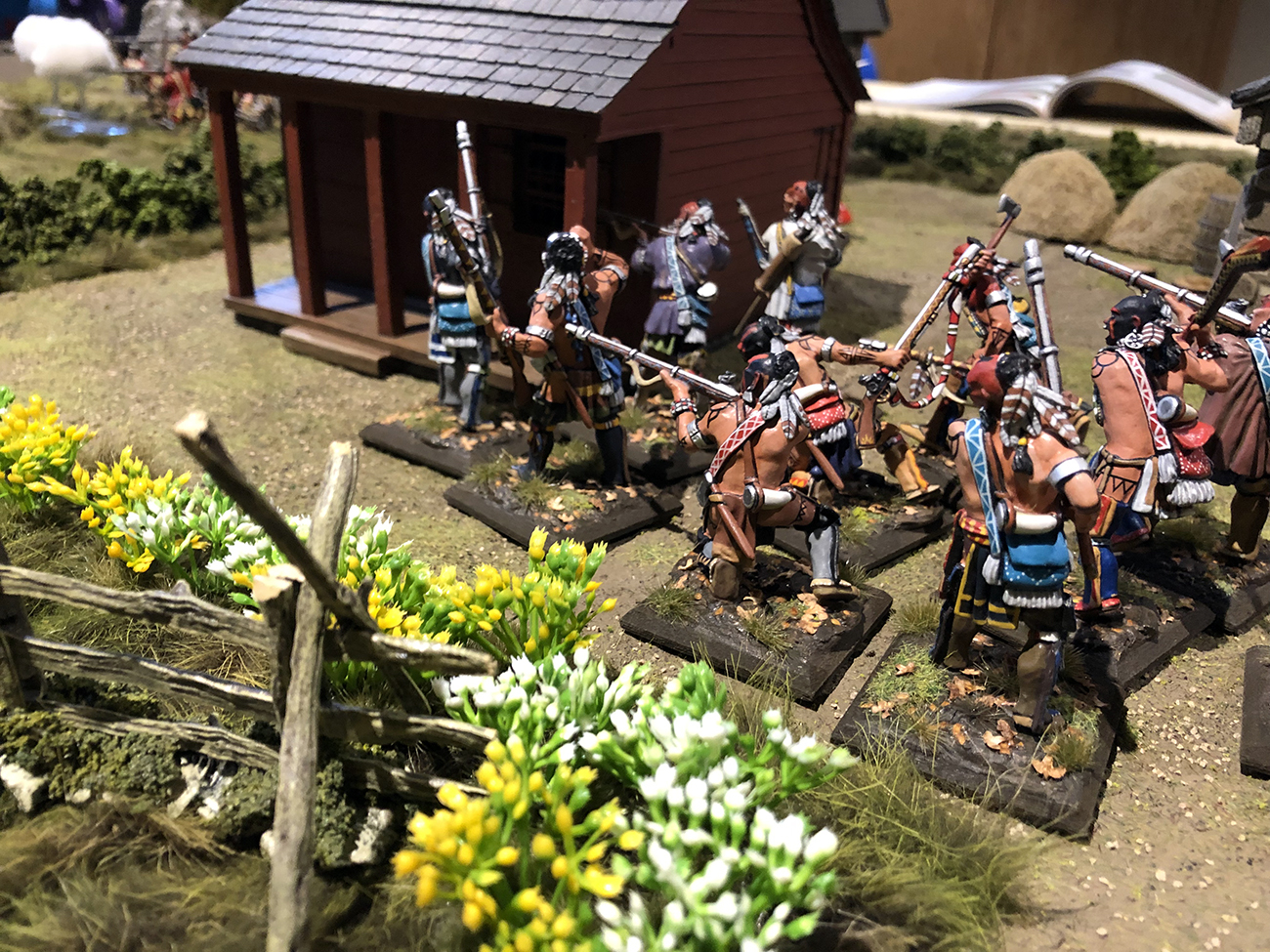
The Indians finally had enough of pot-shooting from the trees and seeing the Ranger fire from the farmhouse dwindle, burst from the woods with a blood-curdling noise!


The Indians attacked the farmhouse, losing a couple of their brothers to Ranger musket fire on the way in. The "tomahawks" rule turned out to be nasty used with a group this big, and the Rangers were overwhelmed and slaughtered.


The loss of the Rangers took the British Force Morale down to "1," so the British conceded, as they were way behind the French on the Morale Track.

What did we think of the game? To a man, our Gang of Four all agreed we want to play Sharp Practice 2 again, despite our intro to the game lasting 6 hours! So why did it take us 6 hours? Well. . . it was our first game and we knew there would be a learning curve, though our later turns seemed to breeze along at a decent pace as our comfort level increased. There were a couple of additional reasons. 

First, about halfway through the first Chapter we apparently thought we had the Hit Effect Table memorized and stopped referring to it, and began only counting Kills in Hard Cover, but not applying the appropriate Shock. This kept all of the groups in the buildings and in the trees (because Skirmishers count as one Cover level higher) operating longer and at full capacity, rather than suffering the effects of Shock.

Second, I gave the Provincial Skirmishers a Moveable Deployment Point they shouldn't have had. Without this Moveable Point, all of the British would have deployed entirely from the Primary Point on the road and the fight would most likely have been less centered on the farmhouse, and been less of a "siege." The Deployment Point mechanics are a feature of the game I really like.

Thoughts on the rules overall? SP2 is fun. The focus on leaders is cinematic and provides a lot of opportunities to effect the course of the battle. Management of your forces, and using the rules to get the best performance from each group under your command, are key to winning on the SP2 battlefield.  

SP2 is not complicated, but it has a lot of moving parts. It is important to fully understand the nuances of the game mechanics. In particular, one needs to understand the differences between Command Initiatives and Activations, and Groups versus Formations. Actually playing the game helps bring it all into focus, and we found the video "tutorials" from the Lardies really helped us in our first game.

I want to play Sharp Practice 2 some more. See ya!