Tulsa TransNational Transport is my fictitious commercial airline company set within the Crimson Skies universe. Part of the official corporate lore:
Tulsa TNT was born in the wake of the Republic of Texas' secession from the United States. Texas annexed American Airways holdings in Oklahoma along with the entire state when Texas declared Oklahoma a "Protectorate." Its current Chief Executive, C. Christophe Cluche', originally a native of "French" Louisiana, was annexed as well, but has done his best to build a thriving aviation entity under the watchful eyes of The Republic. "I prefer a Republic to a Collective, even if it can be damned hard to tell the two apart some days," is a quote often attributed to Cluche' by his defenders, when his affinity for the Oklahoma Freedom Fighters (OFF) is mentioned by his detractors.
Tulsa TNT was basically created to provide plunder and cannon fodder for the pirate gangs and militias of our Crimson Skies games. I have succeeded brilliantly as my dismal record of protecting corporate assets, as well as escort flyers, can attest. TNT's most prized possession, the luxury liner "Jewel in the Crown" has been shot down and resurrected twice already, mainly due to the corporate escorts' inability to protect it.
Following are photos of all of TNT's aircraft assets, with a brief description of each. Enjoy!
The Jewel in the Crown is currently the largest passenger liner in operation out of Oklahoma. Her two main routes are between Tulsa and Austin in the Republic of Texas, and Tulsa to Chicago in the Industrial States of America. The Chicago run is the most hazardous of the two, as the borderland between Dixie and the Collective is fraught with peril, and not just the piratical kind.
(Model note: The Jewel is a stock build of the 1976 Testors HAWK model of the Graf Zeppelin in 1/245 scale. This same kit allows you to model the U.S.S. Los Angeles at 1/200 scale. FYI I reckon the Crimson Skies models to be 1/200 scale and this zep model works well with the Crimson Skies models. I added gun turrets to the Jewel from a WW2-era destroyer model. The Testors HAWK kit has recently been re-tooled and re-released with a "hard" plastic body instead of the soft plastic of the original. I picked up two awhile back at half-price on ebay with the idea of building a military version and maybe a pirate, as well. Some day. . .)
4 Kingfishers provide escort for the Jewel and are physically carried on board, ready at all times to launch in her defense. The Kingfisher is a hardy plane that was designed specifically for zeppelin escort duty. I find it to be slightly under-gunned (that must be why I can't defend the Jewel properly), but it is a great looking aircraft.
The "eyes" of the Escort Wings are provided by the 2 Seers, nimble, lightly armored airplanes with long range and great speed. The Seer makes a great courier, too.
An Albatross float plane provides security in river and lake country.
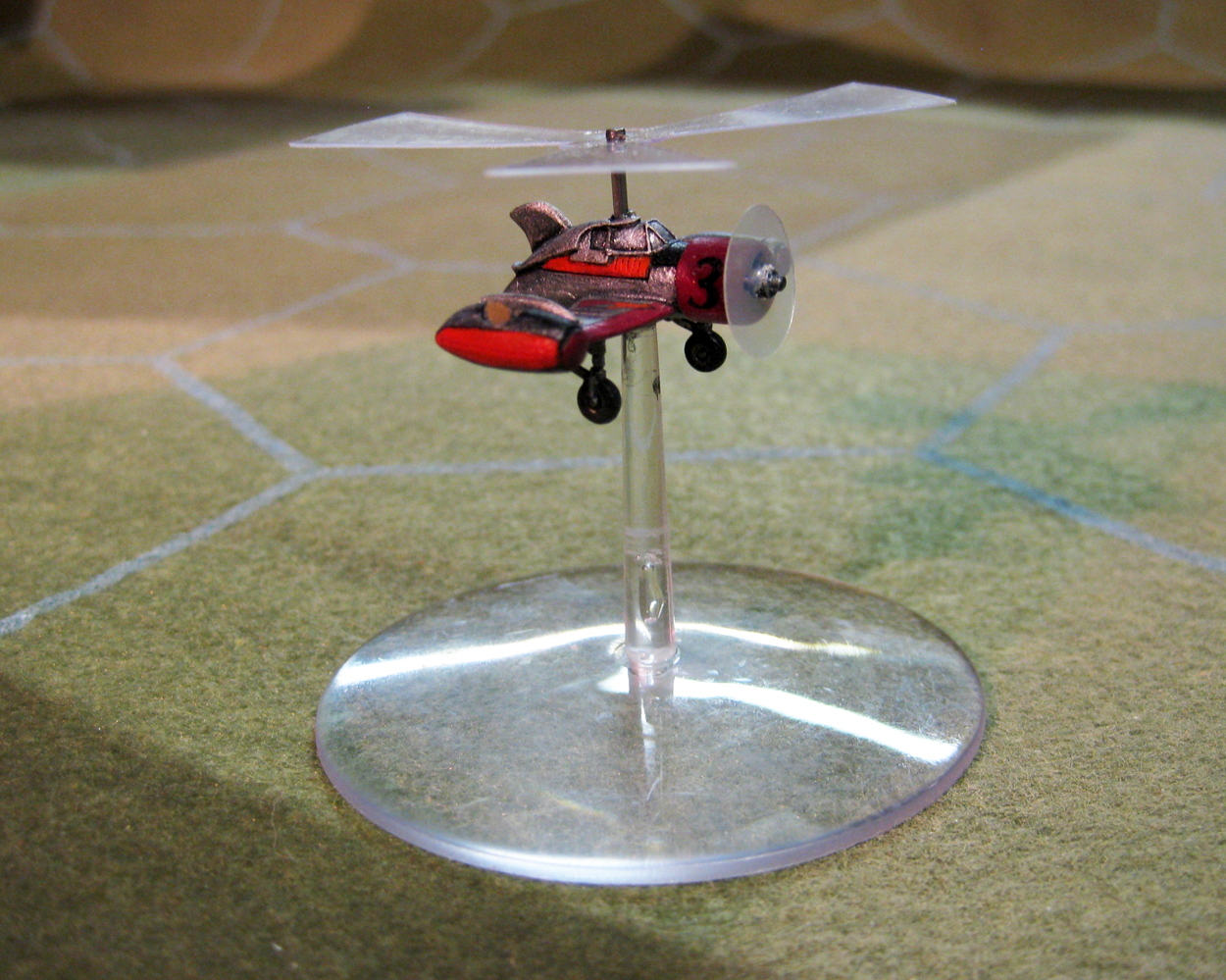
TNT also boasts an impressive fleet of autogyros. The Bird Dog was designed for standard police and security service.
Short-hop commuter service is provided by the pair of Liberte'.
And finally we have a more upscale passenger autogyro, the Metroliner.
Next up for Crimson Skies? The People's Collective militia, the Wichita Windstorm. I'll share when I finish painting.
See ya!
Crimson Skies is a blast. We're talking about FASA's 1998 boardgame, not the Clix version. A simple aerial skirmish game with lite Roleplay aspects, and a great Alternate History of the United States leading up to 1937 as a backdrop for the action, Boardgamegeek describes Crimson Skies thus:
Crimson Skies is a character-based board game of
dogfighting and dive bombing in an aviation-dominated world; a simple,
fast-playing game of pulp-fiction-style air combat. It is a game about
the men and women who pilot flying nightmares, the metal-sheathed birds
of prey that spit death from the sky.
In Crimson Skies, you are at the top of the aviation
food chain - a fighter pilot, one of the fearless men and women who
take to the skies each day for honor or profit. Each player generates a
minimum of two characters, a pilot and his or her wingman. If your
characters survive from mission to mission, they gain experience that
can translate into better skills, and thus even better chances for
future survival and success. While this is a combat board game, not a
roleplaying game, telling tales about your characters will invest the
game with action, drama and humor, making the game-playing experience
even more enjoyable.
This is a fun game that I haven't played for a couple of years; since I moved from Tulsa to the Twin Cities. In Tulsa, we played every couple of months or so, alternating Crimson Skies with other favorite games. In place of the printed map boards and paper counters, we used Hotz Hex mats and the metal models originally from Ral Partha, now available from Ironwind Metals.
We played a campaign of sorts . . . I would generally bring a couple of rough scenario outlines to game day, and then try to adapt one to the players and Militias that showed up to play. Afterward, I would create a narrative based on the actual game we played, adding some back story and intrigue, then publish an episode of "Air Action Weekly," which helped to set up the next scenario.
The casualness of the campaign - such as it was - really fit our style of play and made the games a lot more fun. Another fun aspect for us is that we based our Militias on local history and geography, so we centered our ongoing narrative on Oklahoma.
If you want to follow our campaign, you can download each edition of "Air Action Weekly" below. You'll get a sampling of our toys, too.
Jewel Shot Down Over Ozarks!
Governor "Alfalfa Bill" Murray outruns "Thievin' Savages!"
German Chancellor Hitler Gives Speech on Foreign Policy
Victorinox Payroll Object of Ferocious Dogfight over Dixie!
Blood Feud Lures Patrols into "Thirty Seconds of Fiery Death!"
Renegades Deliver Response to "Thirty Seconds of Fiery Death!"
Texas Fliers Spank Collective Raiders - But Lose New Oil Well.
RAF Earns Collective's Wrath!
More Like Sour Grapes of Wrath!
Mick "Movie Star" Mannock is Hero in Reel - and Real - Life!
Pirates Have Tulsa TransNational "On the Ropes" After Latest Attack!
Texas Threatens War; Collective Denies all Republic Allegations.
Will Texas and the Collective actually go to war? Not sure we'll ever know. . .
And if reading these makes you want to play Crimson Skies, but you can't find the OOP game, despair not, because you can download PDFs of all the original rules and background books from the game below. You'll still need to provide your own hex maps.
Book 1 - The Rules of Air Combat
Book 2 - Warriors of the Air
Book 3 - Aircraft of North America
Counters
Record Sheets
And two supplements you should have (there are several book supplements available, too, but you're on your own for those):
National Air Races
Zeppelins and Bombers
You're welcome!
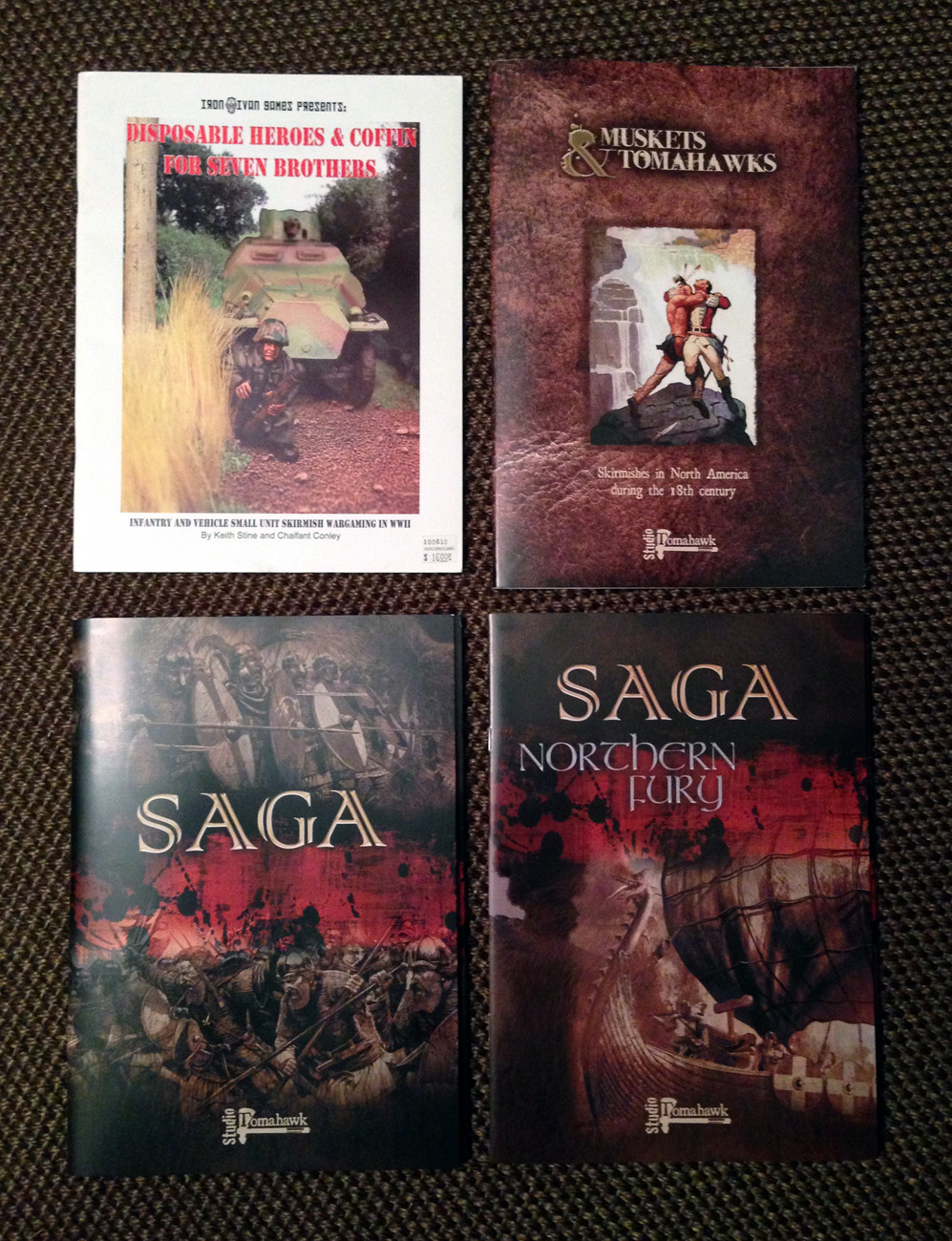
Last week at my FLGS I picked up some new rulebooks. Saga has been all the rage lately and since I love me some Dark Ages, particularly the Norman Conquest kind, I decided to give it a closer look. Since we know the French and Indian War has some appeal for me, Muskets & Tomahawks, from Studio Tomahawk, the creators of Saga, seemed a natural pick-up, too. And since I like my current French and Indian War rules of choice so much, This Very Ground by Iron Ivan Games, I bought their World War Two skirmish set, Disposable Heroes & Coffin for Seven Brothers.
So if I like This Very Ground (TVG) so much, why bother with Muskets & Tomahawks (M&T)? Shiny object - I couldn't resist. And I have an ultimate plan. . .
A campaign, of course. I want to use GMT's boardgame, Wilderness War, as the basis of the campaign.
I have been building my 10-man units with the John Jenkins miniatures to each represent 1 Strength Point from the boardgame. TVG perfectly handles the army level battles generated by the boardgame, but there's a "frontier ravaging" sub-game that is happening simultaneously with the army level that feels like it needs a more intimate scale than the army level. Hence I keep looking at rules. . .
After reading through M&T, I think it could easily fit the bill. In fact, it reads (disclaimer: I haven't played, yet) a lot like TVG. Both games are unit-based; each unit comprised of 4 to 12 soldiers in M&T, 5 to 20 in TVG. Both games activate a unit at a time, and alternate activations. TVG has a more interesting activation system, based on Initiative and player choice; M&T is card-driven, with an option to build hands instead of relying on the draw (I like the option). Again, in both games, each unit moves, shoots and fights before another unit activates. In TVG the soldiers are required to be in a formation and all take the same action. In M&T the soldiers can do different actions, which means that some can fire while others reload, and individual figures have to be marked for reloading. TVG uses a "Volume of Fire" mechanism that allows a single marker to be used for a unit, which I like.
In both games, each combatant has 3 defining characteristics. TVG bases these characteristics on a D10, M&T on a D6. This permits TVG to differentiate unit quality with numbers to a greater extent, M&T relies a bit more on "traits."
Shooting is handled the same in both games; each figure gets a die, rolling to hit and then rolling each hit to wound. Morale tests are taken by unit each time casualties are incurred. Both games handle morale degradation with 3 levels of decreasing effectiveness.
Officers are treated as individual units in both games; unit leaders are handled differently. In M&T, each unit has a leader who by virtue of being a leader is the last casualty in the unit. In TVG, each unit has one or more leaders (non-coms) that can become casualties as part of normal combat, and their loss can have a detrimental effect on unit performance. As officer mortality was quite high in the French and Indian War, I think TVG gets this right.
TVG provides some sample scenarios that can be strung together to form a mini-campaign and encourages the reader to devise their own scenarios, while M&T provides a neat scenario-generation system. M&T also has a system for random events and for "Side Plots" that add some fun and fanciful elements into the canned scenarios.
I like M&T enough to play a few games to get the feel of it, but I am not convinced I will switch from TVG. I may just be able to switch to smaller 5-man units to get the more intimate feel I want for the "frontier war".
I'll get to Saga and Disposable Heroes later.
See ya.
The game I presented at Recruits XX is an abstraction of the Battle of Quebec, fought between the British and the French and their colonial allies, on the Plains of Abraham in 1759. I disregarded Bougainville's detachment and created two opposing forces balanced with the point system provided by the rules to provide a "balanced" convention experience, but otherwise tried to represent the battlefield and the armies within the constraints noted. Based on the feedback from the players, I think I achieved both aims of the scenario design: provide a tense game that either side felt they could win, while providing a sense of the drama inherent in the original conflict.
Above is a scale drawing of the game as presented, each terrain square 12" across, and each "unit" represented by 10 54mm soldiers, or a cannon and 4 or 5 crewmen. The rules played are This Very Ground by Iron Ivan Games. Check out my earlier blog post,
"A Frontier on Fire",
for background on the rules, figures, and how I approach the game. I play the rules straight up with no house rules, because they play really well as written! For this game I made unit cards which gave players access to most of the essential stats needed - I think I am the only person that actually opened a rulebook during the games. Another new addition was the addition of white and red D4s to track Volume of Fire and Disruption levels respectively. The D4s were easy to use and kept the battlefield looking tidy. . . at least until the casualties started to mount, all of them left on the field where they fell.

The scenario was designed as a straight head-to-head clash of mostly European Regulars, with the French having some advantage on the flanks, the British their strength in the center, deployed in some depth with more Officers. Additionally, both armies had a stronger left flank facing their opponent's weaker right flank. To their credit, nearly all of the players recognized the strengths and weaknesses in the respective deployments and at least attempted to play to their advantages.
The main battle lines started within musket range, so the game started as a series of decisions as to which unit should activate and volley first in order to maximize effect. At the end of the first full turn the players were in full command of the musketry rules and just needed me to help with the various modifiers afterward.
So on to the games!
Game One on Friday night at 7pm
For a variety of reasons, my usual helpmates from Tulsa couldn't make the convention, so "thank you very much" to Lead Addict for his spontaneous offer to help me set up the first game and so get it started by 7pm. The armies are set up as shown on the map, the main lines of Regulars and Artillery facing each other across the open field, with the French-allied Natives and Canadian Militia skirmishing from the woods on the flanks.
Musket and artillery fire opened the combat in the center of the field, the French winning Initiative and then dominating the dice contest for most of the game.
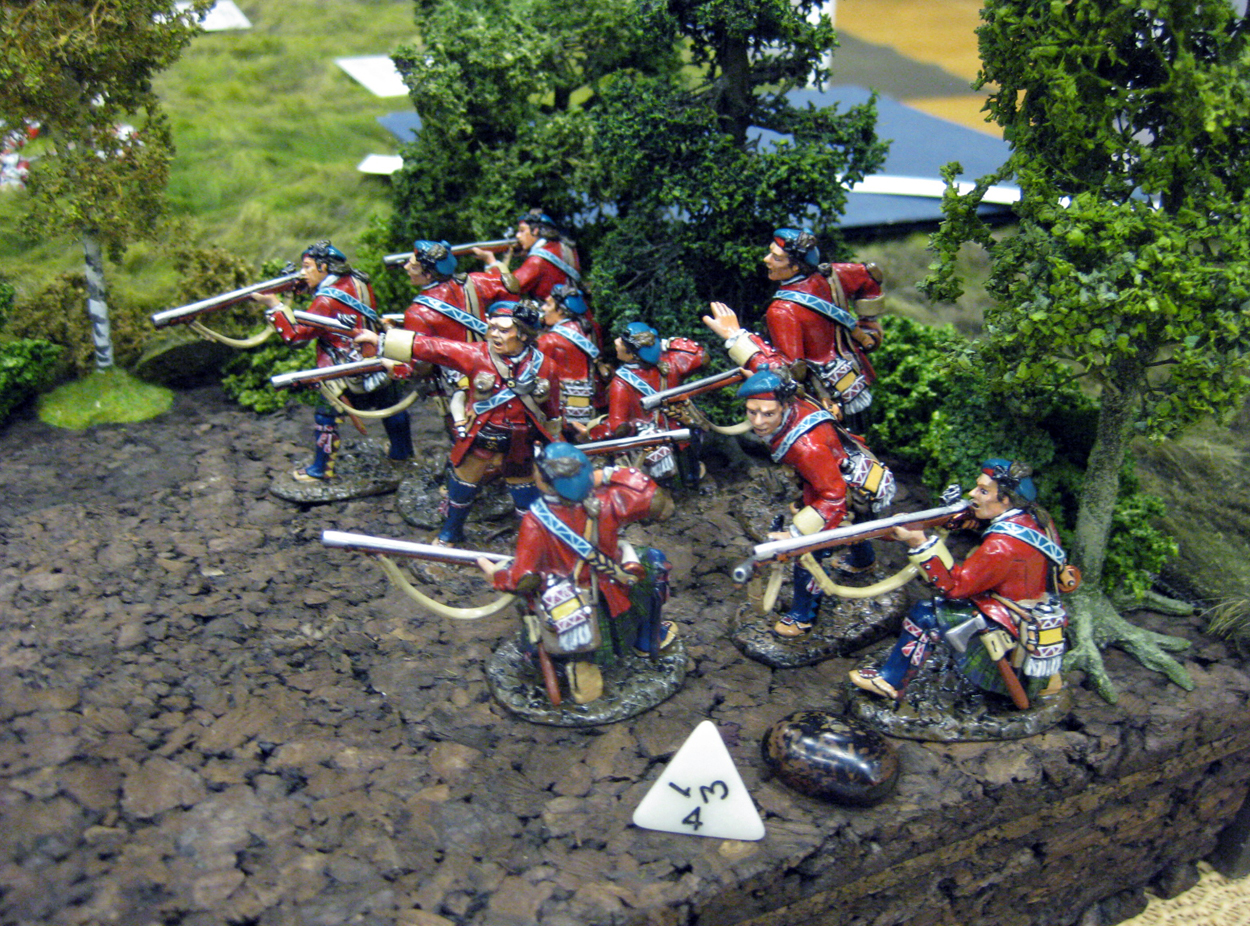
The British had some success on their stronger left flank, as the Light Infantry of Fraser's Highlanders chased off the Indians in the woods and engaged the Canadian Militia. . .
. . . but couldn't hold off the French Marines and Indians on their right flank long enough to win the center. The French win.
Game Two on Saturday morning at 9am
Lead Addict showed up unexpectedly - so thanks again, Addict! - to help set up the game. You'll notice I inadvertently set up the British wide across the Plain with only one company in reserve.
This set-up - along with a series of abysmal opening musketry die-rolls - contributed to a rapid collapse of the British right wing while the left wing roared through the French forces in the woods on their left flank.
The British advance farther on the left flank, getting Grenadiers
of the 47th into the woods, where they rout the Canadian Militia but are
in turn killed to a man by the French Marines. The British center advanced so far forward one of the French 8-pounders was momentarily captured in hand-to-hand combat! But the British sustained too many losses on the way to the gun. . . The French win again. What did we learn? Melee is brutal - don't charge the enemy unless you have more soldiers than he does!
Game Three on Saturday afternoon at 2pm
Same set-up as Game Two. French out-roll the British again over at least the first half of the game and the battle plays out in similar fashion to the previous. Third French win.
Game Four on Saturday night at 7pm
Armies are set up per the map. I am getting tired. . . and know we probably won't have time to finish this game. The British win Initiative and proceed to reverse the French dice luck of the previous games.
With the coaching help of a "repeat" player from Game Three, the British neutralize the skirmishing fire on the flanks by Disrupting the Natives, then draw in their flank guards and push up the middle.
When we had to end the game due to time, the British had broken 3 French Units versus none of their own and looked on the way to a win. So we all "agreed" the British won.
Thanks go to the players of Game Four that helped me tear down the game, and to the Recruits staffer that helped me load the car - THANKS!
The more I play This Very Ground, the more I appreciate the game it provides. The new grass mat was an aesthetic success and got lots of positive comments from onlookers. We had a bit of a challenge with some of the figures not standing consistently on the uneven surface of the mat, so I may need to work out a fix of some sort.
Addict, I hope The Battle of Quebec was worthy of Recruits XX : )
See ya!
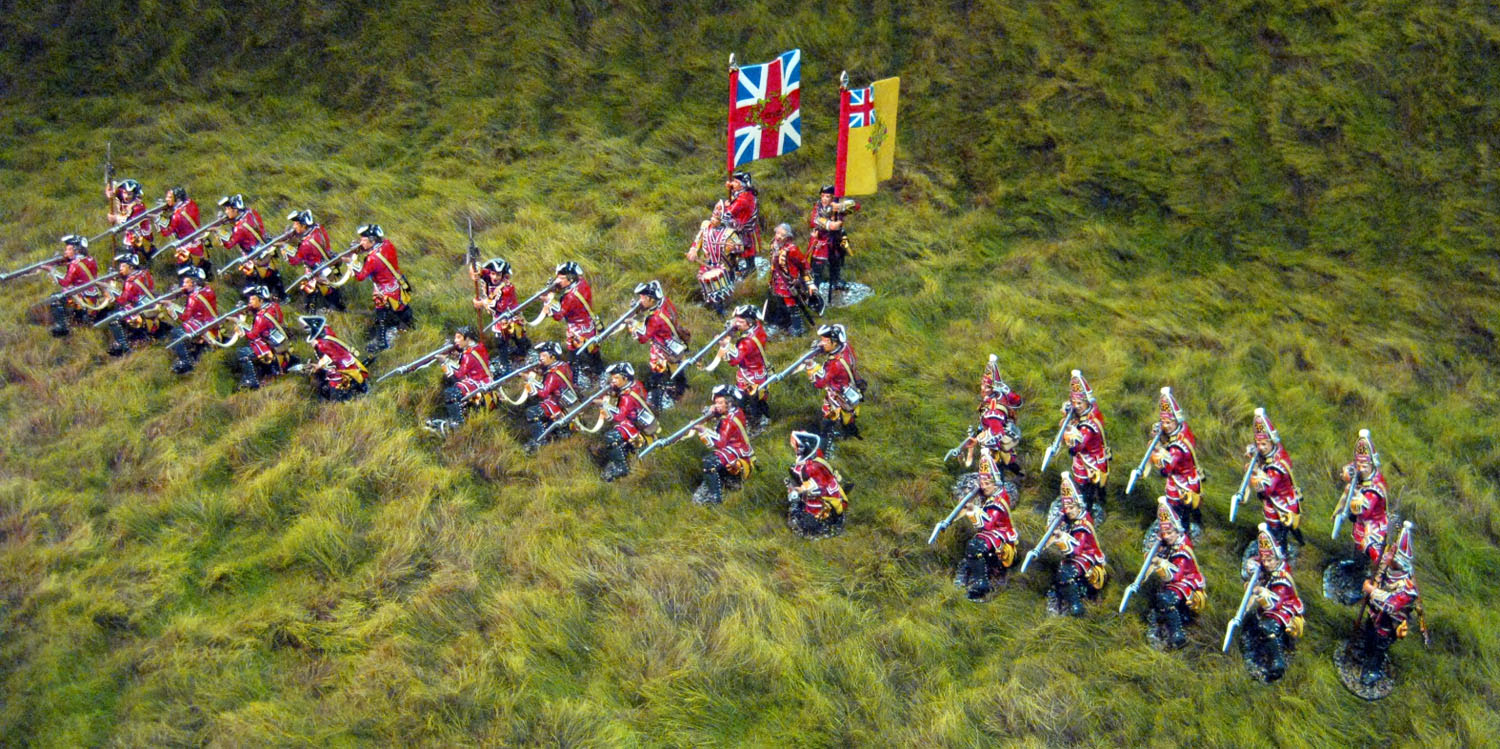
Lt. Colonel Hunt Walsh deploys the 28th Regiment in time for Recruits. The 28th will be represented by 2 companies of line Regulars and one company of Grenadiers.
All of the soldiers for the Battle of Quebec are varnished and ready for action. We'll have 250 54mm figures, give or take, and 3 cannon on the field of honor. Three games are scheduled; rules will be This Very Ground by Iron Ivan Games.
Come see us at Recruits XX in Kansas City on September 14th - 16th.