Tuesday, July 4, 2017

Independence Day and Muskets and Mohawks


 Here is the revisit of our Muskets and Mohawks game I promised, sort of a "colonial nod" to July Fourth given the timing of the post.

Muskets and Mohawks (from Two Hour Wargames) represents small-unit skirmishes in the French and Indian War with 10-man units (artillery are 5-man), each with a Leader. Basic types of troops are Regulars, Militia, Irregulars, including Indians, Civilians, Gunners and Cavlary. Regulars can also be further identified as Grenadiers, Guards or Lights. Units are in 1 of 3 formations: Formed Line, Mob or Unformed (skirmish). "Higher" formations are possible: 2 units make a Platoon and get an extra Leader, 2 Platoons make a Company, etc. Irregulars form "War Parties." The names are general enough to be whatever scale you want.

The heart of the system is Rep and Reactions. Each unit and Leader is assigned a "Rep" between 2 (raw civilians) and 6 (warriors of great reknown). During the game units test against their Rep using 2d6 (with some modifiers that add or subtract d6) when certain events occur or when certain actions are desired. You pass a d6 by rolling equal to or lower than the Rep. These are called Reaction Tests:

Received Fire
Received Casualty
Leader Lost 
Rally or Form Line
Charge Into Melee
Take Trophies
Fast Move
Controlled Volley*

When several Tests are required to be taken (for example if a unit Receives Fire that causes a Casualty, which turns out to be the Leader) you roll once and apply the result to all the tests, taking the worst result. Potential results of the tests are, generally, from best to worst: Carry On (pass 2d6), Retire (pass 1d6) and Run Away (pass 0d6). The presence of Leaders, units in support, type of Unit and Formation all provide nuance and are all listed on the Reaction Test charts, so is not a test of the players' memories, too!

One side activates their units or leaders, moving from right to left across the field, after which the other side does the same, so the activity swirls around the table in a "clock-wise fashion." As each unit activates, it can take ONE action, which include moving and changing formation, charging, firing and reloading. Each unit takes its action, and all units take any reaction tests caused by the action before moving on to the activation of the next unit.

All foot movement is 8"; terrain modifies formations used rather than rate. Fast Movement is possible when 24" or more from known enemy. Formations limit or enable movement dependent on terrain. Units can go Prone, too.

Musket range is 18"; rifle range is 24". There are two types of Fire: Fire At Will and Volley. Firing at Will uses the number of d6 of the unit's Rep, with some modifiers (like +2d6 for firing at Formed units) and one casualty is caused by each "1" rolled. Another roll determines if a Leader was a casualty. When units begin Firing they must continue to Fire At Will until one side Retires or Runs Away, after which they must spend an Activation Reloading before they can move again. Volleys can only be fired if a unit is in Formed Line and Reloaded. 1d6 is rolled for each figure in the unit (plus some modifiers) so a full unit starts with 10d6! 

Melee is bloody, and requires a Charge Test, which both sides take and elegantly represents both the attacker's elan in the charge and the defender's will to stand.

There are rules for terrain, reinforcements, campaigns, scenarios, hidden movement and a novel AI to play solo against. This is a solid set of rules. . . but once again I prove that reading is not enough. . . you have to play them to really understand them!

So, to understand the rules, Aaron and I set up a simple meeting engagement game, with a section of open terrain to maneuver the Regulars, and some woods for the Irregulars. 


Aaron took the French and Indians, which left me the British and Colonials. We each had 6 units and decided to start whatever troops we wanted to on the long edges, and to bring in any remaining units when desired as reinforcements.

The colonial Rangers (Irregulars, Rep 4, Leader Rep 5) face the French Marines (Irregulars, Rep 4, Leader Rep 5) in the woods (visibility and musket range reduced to 12") while the British and French Regulars march toward each other in the open, the French in Mob formation and the British in Formed Line.


The British Regulars advance to the creek and fire the first volleys - one completely ineffectual and one that causes several casualties. Regulars are stoically tough, and the French pass their Reaction Tests and Carry On, shaking out into Line in their next Activation and then an Activation later, returning Volley fire (we're using cotton balls to represent "smoke" and that a unit needs to "Reload").


The French bring on a unit of Coureur (Irregulars, Rep 5, Leader Rep 5, Rifles) in the woods, and the British respond with a unit of Militia (Militia, Rep 3, Leader Rep 4) - no match for the Coureur in the woods but the British have no more uncommitted Irregulars! The Rangers and Marines are now locked in a firefight, like the Regulars, until one or the other is forced to retire.


But nobody Retired or Ran Away! Both sides blazed away at each other, taking casualties and losing Leaders. The Coureur began sniping away at the British Regulars, so the British brought up a second unit of Militia in support. The French responded with a Unit of Indians (Irregulars, Rep 4, Leader Rep 5) in the woods, who despite talking some fire from the Militia, successfully charged them and piled into Melee. The fight was bloody on both sides, but the Militia was killed to the last man, right before the Marines' last soldiers died to Ranger musket fire.


Both sides called forth their last reinforcements; the French their last unit of Indians and the British a unit of Regular Grenadiers (Regulars, Rep 5, Leader Rep 5). I was loathe to use the Grenadiers in the woods, but I had no other counter to the Indians.

The Rangers Reloaded and fell on the rear of the Indians that had killed the MiIitia, and died to the last man, one ferocious warrior responsible for at least 4 Rangers on his own!

One unit of French Regulars was wiped out, and when the other was forced to Retire, the British Regulars Reloaded and crossed the creek under fire from the Coureur (also under fire themselves from the Militia) and the remaining French Regulars.


The Grenadiers finished off the remnant of the victorious Indian unit, which triggered the entrance of the last Indian unit. When the last French Regular unit was eliminated, what was left of the British Regulars and Militia advanced on the still dangerous Coureur, though they would eventually be whittled down to nothing. That left French victory down to the fresh unit of Indians tearing through the woods toward the bloodied Grenadiers!


That left the Leader of the Grenadiers with a critical decision: hold fire and take the Charge of the fresh Indians with loaded muskets (removing a negative modifier for Receiving a Charge Unloaded) or Firing first and creating an opportunity for the Indians to fail a Reaction Test. Melee would be bloody. . . so the Grenadiers Fired. . . and caused a single casualty. The Indians failed their Reaction Test - rolling two "6's" - and being Irregulars, Ran Away! 
The British breathe a huge sigh of relief. . . and marvel at their luck. . . 

So after a serious play-through, what did we think of the rules? We liked the overall feel and play: simple, elegant and intuitive, once you understand the Reaction Tests. I particularly like the Firing rules - firing by Rep and tracking fire as a unit with casualties caused on a single die result instead of separate rolls for hits, wounds and saves. One thing bothered us. . . too many units died to the last man. We expected the Reaction Tests - in effect, the morale system - to have a more dramatic impact.

Did we do something wrong? Of course we missed some small rules, modifiers and such, the way you always do at first, but did we do something majorly wrong?

Yup. I took a deep dive into the rules. . . and discovered we were doing two important things wrong.

First, when taking multiple Reaction tests, we should have rolled the dice ONCE, and used the same roll for all the tests, taking the worst result instead of rolling each test separately. Second, and even more importantly, on the Reaction Test chart, when passing 1d6 and having to roll again with one die, that test is taken against the LEADER Rep, not the UNIT Rep, and if the Unit doesn't have its Leader it automatically passes 0d6. These are big differences and should make the units behave a little more dramatically. We plan to play again this month and see!

I'll end with a teaser for Recruits in Lee's Summit, MO next month, where we'll be supporting The Baron and Fistful of Lead with our big toys : )

* Controlled Volley is a "house rule" I wrote when I couldn't find a way to do something I am pretty sure should be allowed. It got the official nod here.


Sunday, June 25, 2017

Muskets and Mohawks


We played our first full game of Two Hour Wargames' Muskets and Mohawks on Saturday at The Source in Roseville, MN. It was the first time Aaron and I played together and the game was a real nail-biter.


The Source was very welcoming and even provided a hand-cart to unload and load the game terrain - anyone who's ever seen me pack this project around knows a cart is a god-send!
Stay tuned for an AAR and some thoughts on the rules in the next week or so.

See ya!


Sunday, June 18, 2017

In space no one can hear you scream "Wagons ho!"


This is a close-up photo of my new "space" mat from Cor-Sec Engineering. I bought the 80" x 60" size as a basis for my enlarged 1/2500-scale StarTrek: Attack Wing project - or whatever I end up playing. Says Cor-Sec:

Our mats are printed on heavy fleece. This synthetic fiber allows for a durable and vibrant mat. The colors are not shiny like vinyl mats.  It is 100% Polyester. It doesn't fray and can be folded or machine washed. They can be transported easily and hold up to heavy use.

The mat is very light-weight, the printed color is vibrant and the edges are folded and "hemmed" for durability.


So why Wagons ho?! I got a new wagon. The new Conestoga wagon from John Jenkins Designs. It's very cool (can an 18th-century wagon be cool?) with a complicated bit of hook and chain harnessing for 6 horses. It will be very complicated to "move" during a game so it may become part of a set-piece terrain unless I figure out a way to base it with horses that is functional and looks good. Might be a tall order. . .


And. . . if you happen to live in the Twin Cities, you are invited to play Muskets and Mohawks with us at The Source this Saturday afternoon. No experience necessary : )

Happy Father's Day!
 

Monday, May 29, 2017

Memorial Day, Martian Legion and Two Hour Wargames


Jack is no longer with us, but he wants to make sure we remember to thank our veterans for their service and their sacrifices on this Memorial Day. I think those of us who turn history into games have a special responsibility to remember those who made the history in the first place.

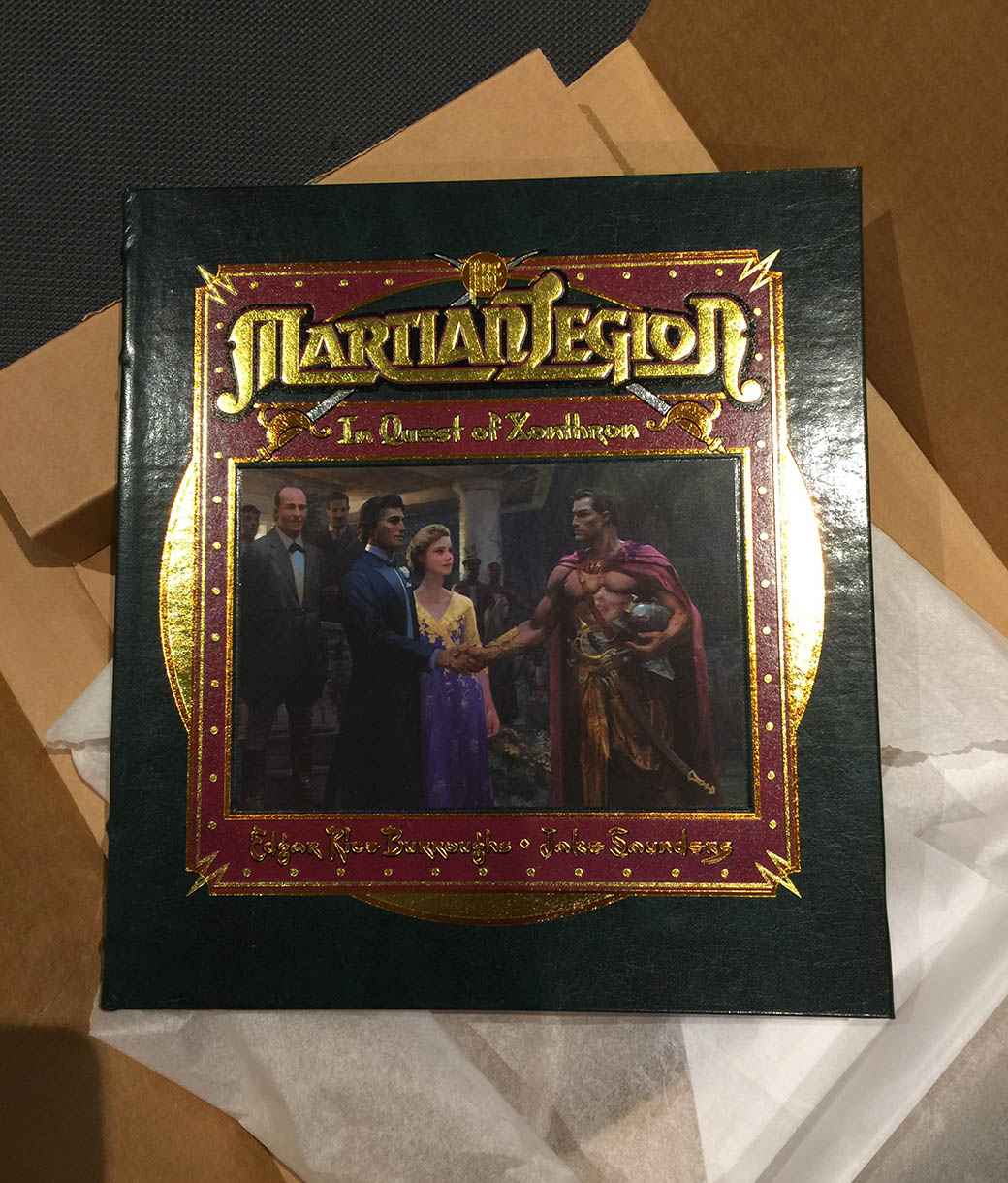
Next topic: there's a book called The Martian Legion that I was able to resist for a long time. But I caved; it's about John Carter and Barsoom, after all. And every other character ERB ever created. . . and just about every other Pulp character ever created. It is a big, beautiful over-priced book that is supposed to be a big, beautiful mash-up of ERB and The Pulps. I have a feeling I'll be underwhelmed by the big, beautiful mash-up but the book itself is big and beautiful and the paintings by Craig Mullins are EXACTLY how I picture Barsoom.

The unveiling. . .


It is beautiful. . .

Next Topic: Two Hour Wargames. They are not for everybody, but I am a fan of the "reaction" mechanics and the way that you are forced to manage the battle as opposed to commanding it. The only character you are ever in complete control of is YOU, no matter what set of rules you are playing. . . or genre or level of command. AND you can play solo. Really solo, against the game rather than just playing both sides "honestly." AND the "fog of war" is real, due to the game mechanics. Watching the movie Midway this morning reminded me just how critical that "fog" is to a more "realistic" impression of history in our games.

So I am going to spend some time playing through some THW rules for the French and Indian War and World War 2, and eventually Sci-Fi and Pulp (Barsoom, again?). Not exclusively, but seriously.


See ya!
 

Sunday, May 21, 2017

Stupid Human Tricks, Colonial-Style. . .


While reading A Wilderness of Miseries by John E. Ferling, I came across this passage in a chapter about typical military discipline during the American Revolutionary War that surprised me:

"Some of the orders were designed to protect the troops from one another, to prevent accidental or deliberate injuries; for instance at the outset of the war officers were notified to fine soldiers around Boston who tried to catch British-fired cannon balls before they stopped bouncing."

Who has to be told, under threat of fine, not to catch a cannon ball?

Monday, May 1, 2017

Dead Trees Are Done!


Finished the bases for the "dead trees" this weekend, including adding magnets to the center of the bottom of the bases to help hold them in place both on the game table and in their travel box. Next up are some boulders on new cork squares.

I've been spending some time with the Sharp Practice 2 rules from Too Fat Lardies for my French and Indian War gaming. I want to set up a solo run-through soon. SP2 has lots of interesting ideas but lots of "moving parts," too. 

Who's played Sharp Practice 2 and what do you like or not like about it?

Sunday, April 23, 2017

Fiinally Finished the Beast. . .


Well, it took a while. . . partly because I don't plow through one book at a time. . . and partly because the Butterfly Brain gets distracted by all sorts of topics both historical and contemporary. . . and partly because An Invincible Beast is a bit of a dense read. I'm a big fan of Dr. Matthew's combination of research into primary sources with physical recreation, ballistics testing and re-enactment, but it is not exactly summer beach-reading.

On page 399, Dr. Matthew summarizes (sorta):

Diodorus declared that 'Macedonian spears had conquered Asia and Europe.' The organization of of Hellenistic pike formations onto units and sub-units, combined with an elaborate and symmetrically distributed command structure, made the pike-phalanx a very ordered instrument of war - one that was mutually supporting, offensively and defensively strong, and adaptable to the varied tactical requirements of the ancient battlefield. Phalangite formations, for example, could be deployed to different depths, with the most common being that of sixteen ranks deep, but could also be arranged in deeper or shallower configurations depending upon the terrain, the size of the opposing force, the decisions of those in command and the situation of the day.

It seems that pike phalanxes were in a more open order than usually depicted, to make room for 5 ranks of deployed pikes, and the great length of the pikes were generally used to hold the opposing forces at bay. 

This allowed the pike-phalanx to effectively pin an enemy formation in place as part of the standard tactic of pike-phalanx combat - that of the hammer and anvil. Across the entire Hellenistic Period this tactic of using the pike-phalanx in the center to hold an enemy formation (or part thereof) in position while other, more mobile troops swept around to strike from the flanks remained unchanged. This in itself demonstrates the integral part that the pike-phalanx played in the conflicts of this time period.

While the functionality of the phalangite remained little changed cross the Hellenistic Period, the tools and strategies of war constantly developed in attempts to overcome the advantages held by the pike-phalanx, particularly during the time of the Successors following the death of Alexander the Great in 323BC when pike-phalanx fought pike-phalanx and a decisive tactical advantage of some kind was required to secure victory. Consequently the sarissa (pike) itself became longer to outreach an enemy armed in similar fashion, and beasts such as elephants were more regularly employed to try and smash an opposing formation apart. Many of these tactical 'experiments' met with mixed results; the pike could only be increased in length until a point was reached where it was almost impossible to wield, and contingents of elephants could be countered with other elephants, a solid wall of pikes, missile troops or other measures. As a result, the phalangite, and the pike-phalanx, retained its position of supremacy on the battlefield.

Yet for all its advantages, the pike-phalanx did have its limitations. This was mainly the potential for gaps to open in the line - due in part to the phalanx being comprised of semi-independent units and sub-units. If such gaps could be exploited by a more mobile opponent, one who could get inside the rows of projecting pikes, this was when the pike-phalanx was most vulnerable as the long sarissa made the phalangite a very ineffective individual combatant, and larger units were incapable of turning to meet threats from the sides once their pikes had been lowered. It was the ability of the Roman legionaries to take advantage of this inherent weakness in the Hellenistic pike-phalanx which ultimately led to the formation's demise.

 Sounds like DBA to me : )

If you want to know how the Romans defeated the pike-phalanx, or exactly how it was organized, or when and where it was first developed, and by who, you'll have to read the book.

I stumbled onto another book when looking up the author John Ferling, some of whose work about the Revolutionary War I have read - but I was not familiar with A Wilderness of Miseries, which is about the "warriors" of colonial America. Its sociological angle immediately drew me in. I AM "plowing" through this one!


I'll have some more F&IW terrain to show soon, as well as some thoughts on rules for the period I am considering.

See ya!